

Ancients Thought that the Human Heart was actually the “Brains”
The early civilizations lacked adequate means to obtain knowledge about the human brain. However, from the ancient Egyptian mummifications to 18th century scientific research on “globules” and neurons, there is evidence of neuroscience practice throughout the early periods of history.
Early views on the function of the brain regarded it merely to be a form of “cranial stuffing” of sorts. In ancient Egypt, from the late Middle Kingdom onwards, in preparation for mummification, the brain was regularly removed, for it was the heart that was assumed to be the seat of intelligence.

According to Herodotus, during the first step of mummification: “The most perfect practice is to extract as much of the brain as possible with an iron hook, and what the hook cannot reach is mixed with drugs.”
 This is where we get the phrase: “memorizing something by heart”.

During the second half of the first millennium BC, the Ancient Greeks developed differing views on the function of the brain. However, due to the fact that Hippocratic doctors did not practice dissection, because the human body was considered sacred, Greek views of brain function were generally uninformed by anatomical study.
It is said that it was Alcmaeon of Croton (6th and 5th centuries BC) who first considered the brain to be the place where the mind was located. According to ancient authorities, “he believed the seat of sensations is in the brain. This contains the governing faculty. All the senses are connected in some way with the brain; consequently they are incapable of action if the brain is disturbed…the power of the brain to synthesize sensations makes it also the seat of thought: “The storing up of perceptions gives memory and belief and when these are stabilized you get knowledge.”

A wood carving print of the dissection of an animal
In the 4th century BC Hippocrates, believed the brain to be the seat of intelligence.

Hippocrates
However, during the 4th century BC Aristotle still thought that, while the heart was the seat of intelligence, the brain was merely a cooling mechanism for the blood. He reasoned that humans are more rational than the beasts because, among other reasons, they have a larger brain to cool their hot-bloodedness.

Aristotle
When did the concept change from heart to brain?
In contrast to Greek thought regarding the sanctity of the human body, the Egyptians had been embalming their dead for centuries, and went about the systematic study of the human body. During the Hellenistic period, Herophilus of Chalcedon (c.335/330–280/250 BC) and Erasistratus of Ceos (c. 300–240 BC) made fundamental contributions not only to brain and nervous systems’ anatomy and physiology, but to many other fields of the bio-sciences. Herophilus not only distinguished the cerebrum and the cerebellum, but provided the first clear description of the ventricles. Erasistratus used practical application by experimenting on the living brain.

A depiction of anatomical theatre during medieval times
Their works are now mostly lost, but we know about their achievements mostly due to secondary sources. Some of their discoveries had to be re-discovered a thousand years after during the medieval times.

A quick overview of the topics covered in this article.
Latest articles
The Cognitive Rent Economy: How Every App Is Leasing Your Attention Back to You
You don’t lose your attention anymore. You lease it. Modern platforms don’t steal focus. They monetize it, slice it into intervals, and return it [read more...]
AI Is an Opinionated Mirror: What Artificial Intelligence Thinks Consciousness Is
Artificial intelligence thinks it sees us clearly. It does not. It is staring into a funhouse mirror we built out of math, bias, hunger [read more...]

The Age of the Aeronauts: Early Ballon flights
Humans have always wanted to rise above the ground and watch the world shrink beneath them without paying a boarding fee or following traffic [read more...]

Free Energy from the Ether – from Egypt to Tesla
Humans have always chased power from the invisible. From the temples of Egypt to Tesla’s lab in Colorado, inventors sought energy not trapped in [read more...]
The Philosophy of Fake Reality: When Simulation Theory Meets Neuroscience
What if reality isn’t breaking down—but revealing its compression algorithm? Neuroscience doesn’t prove we live in a simulation, but does it show the brain [read more...]
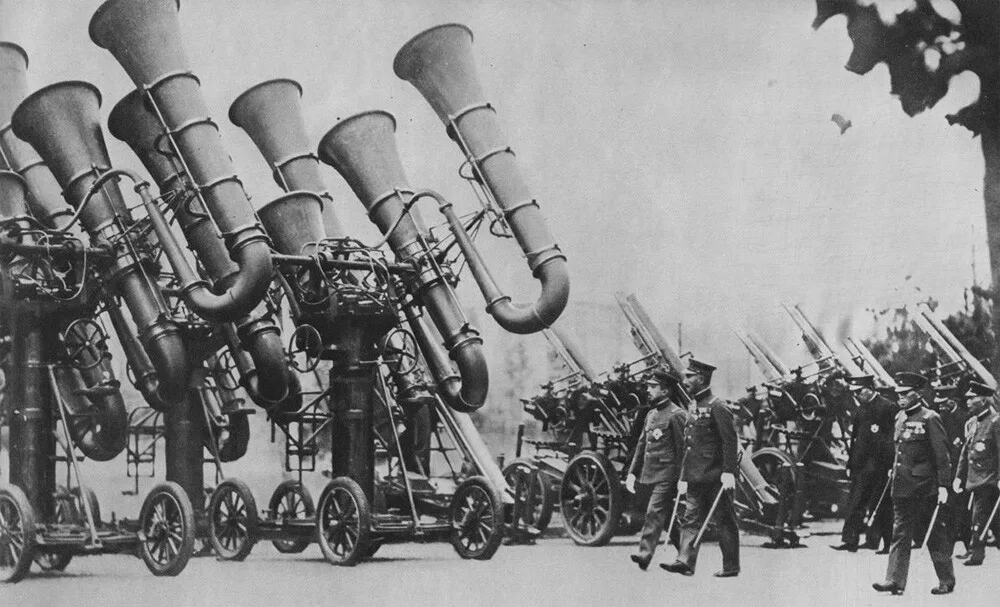
Blast from the Past: Exploring War Tubas – The Sound Locators of Yesteryears
When it comes to innovation in warfare, we often think of advanced technologies like radar, drones, and stealth bombers. However, there was a time [read more...]
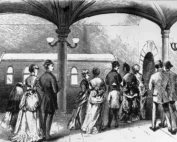
Pneumatic Tube Trains – a Lost Antiquitech
Before electrified rails and billion-dollar transit fantasies, cities flirted with a quieter idea: sealed tunnels, air pressure, and human cargo. Pneumatic tube trains weren’t [read more...]

Tartaria and the Soft Reset: The Case for a Quiet Historical Overwrite
Civilizations don’t always collapse with explosions and monuments toppling. Sometimes they dissolve through paperwork, renamed concepts, and smoother stories. Tartaria isn’t a lost empire [read more...]

“A problem cannot be solved by the same consciousness that created it.” – Albert Einstein
“A problem cannot be solved by the same consciousness that created it.” - Albert Einstein

Tartaria: What the Maps Remember
History likes to pretend it has perfect recall, but old maps keep whispering otherwise. Somewhere between the ink stains and the borderlines, a ghost [read more...]


