The Oracle of Delphi: Where Gods Whisper Through Gas
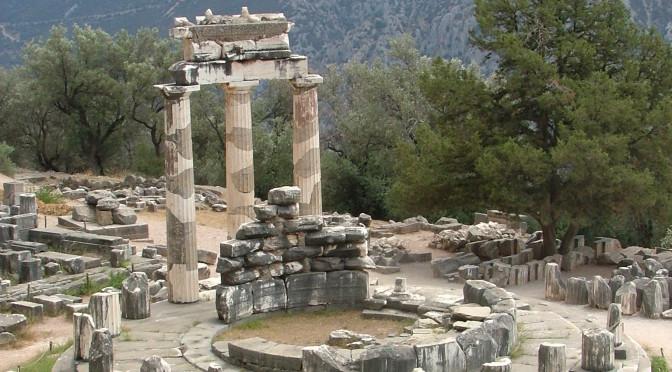
Delphi isn’t just an archaeological site; it’s a signal tower for human imagination. On the south-western spur of Mount Parnassus, the valley of Phocis cradles the omphalos, or navel of Gaia — the literal center of “Grandmother Earth” as determined by Zeus, who sent two eagles from opposite horizons to meet above Delphi. Myth, power, and a dash of celestial GPS.
Delphi: Center of Earth and Human Curiosity
By the classical period of Ancient Greece (510–323 BC), Delphi had already become the spiritual Wi-Fi hub of the known world. Kings and city-states didn’t consult Google; they waited for whispers carried by the Pythia. And this wasn’t one woman delivering messages; it was a centuries-long relay of priestesses, each stepping in as another left, a chain of human conduits channeling Apollo’s voice.
Delphi: where Zeus’ eagles intersected, humans waited, and the divine got broadcast like ancient Wi-Fi. Share on X 
The Pythia: Human Conduit of the Divine
The Pythia’s fame wasn’t fluke; she was the ultimate interface between earth, human, and god. Some scholars argue she didn’t mumble nonsense; she spoke clearly, and her rhythm, her iambic cadence, was the poetry of prophecy itself. Vapors rising from chasms — ethylene, methane, CO2, H2S — might have made her trance more literal than spiritual (Scientific American on Delphi gases). Myth, geology, and chemistry entwined in every breath she exhaled.
The Oracle wasn’t just a mouthpiece; she was a seismic node of human curiosity. Every utterance demanded attention, translation, interpretation, and awe. Writers from Plato to Thucydides chronicled her words, capturing the tension between what humans could see and what they could imagine. The Pythia didn’t invent drama — she embodied it.
The Pythia spoke, and humans leaned in, listening for the gas between earth and god. Share on X
Delphi Through Time: Myth, Matter, and Memory
Delphi’s aura persisted for over a millennium. By the 8th century BC it had cemented itself as a cultural and spiritual touchstone; by 395 AD, Emperor Theodosius I’s decree ended pagan temples, and the oracle fell silent. Yet her imprint endures — etched in literature, philosophy, and the chemistry of curiosity.
The name Pythia comes from Pytho, a nod to the monstrous Python slain by Apollo, whose decomposition (pythein — “to rot”) may have fueled the vapors that catalyzed prophecy. Science now pokes at the same fissures: gas analysis, seismic observation, and chemistry all intersect where human wonder meets natural phenomena (National Geographic on Delphi). Delphi reminds us that the boundary between human and divine, myth and matter, is sometimes just a crack in the rock.
Delphi: a place where myth, matter, and gas conspired to make humans lean closer to the divine. Share on X

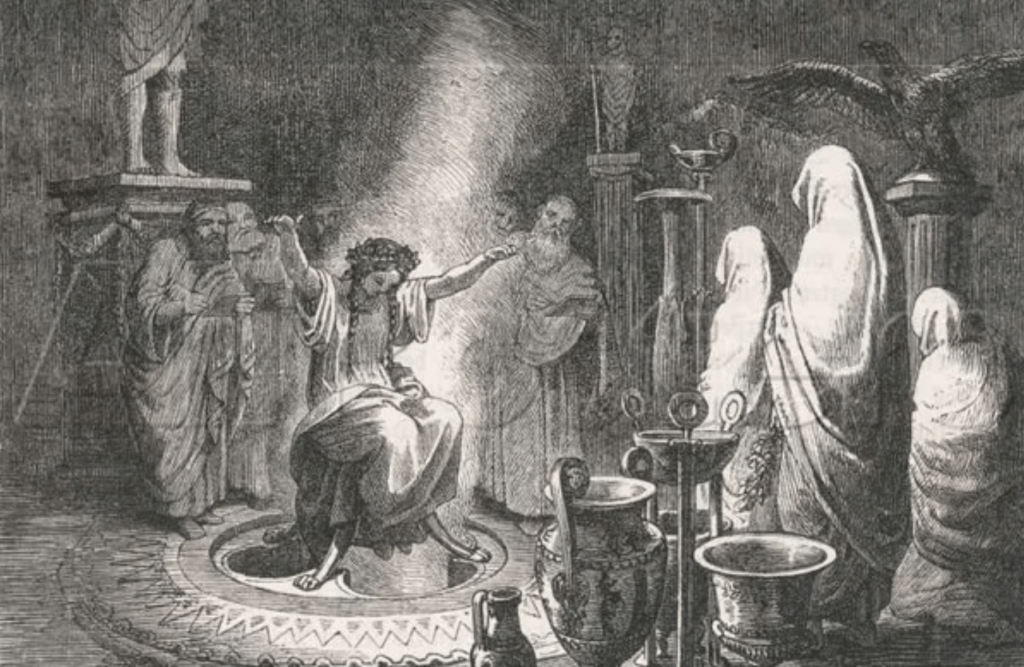
Priestess of Delphi (1891) by John Collier

A quick overview of the topics covered in this article.
Latest articles

The Cognitive Rent Economy: How Every App Is Leasing Your Attention Back to You
You don’t lose your attention anymore. You lease it. Modern platforms don’t steal focus. They monetize it, slice it into intervals, and return it [read more...]

AI Is an Opinionated Mirror: What Artificial Intelligence Thinks Consciousness Is
Artificial intelligence thinks it sees us clearly. It does not. It is staring into a funhouse mirror we built out of math, bias, hunger [read more...]

The Age of the Aeronauts: Early Ballon flights
Humans have always wanted to rise above the ground and watch the world shrink beneath them without paying a boarding fee or following traffic [read more...]

Free Energy from the Ether – from Egypt to Tesla
Humans have always chased power from the invisible. From the temples of Egypt to Tesla’s lab in Colorado, inventors sought energy not trapped in [read more...]
The Philosophy of Fake Reality: When Simulation Theory Meets Neuroscience
What if reality isn’t breaking down—but revealing its compression algorithm? Neuroscience doesn’t prove we live in a simulation, but does it show the brain [read more...]
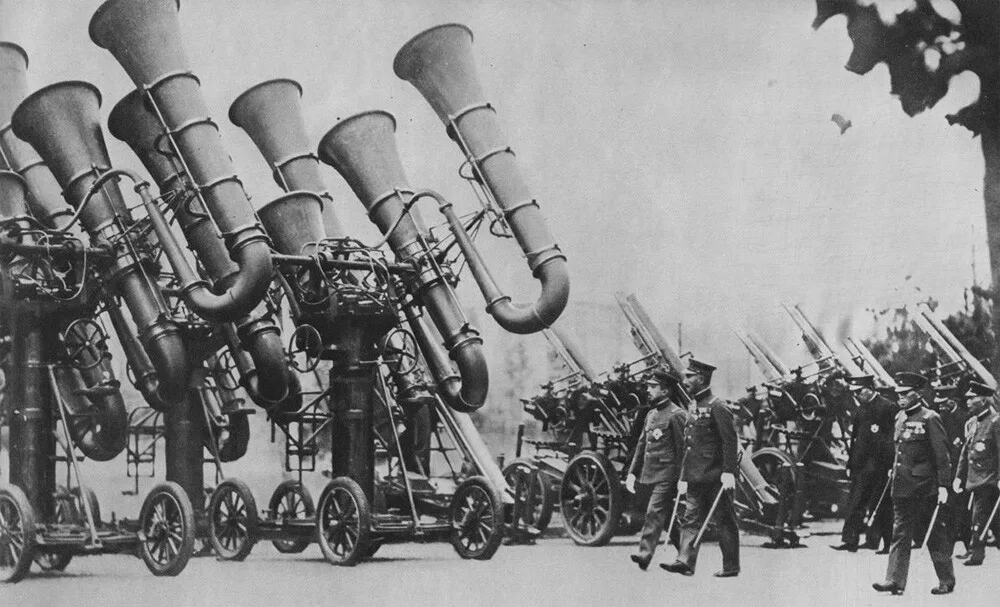
Blast from the Past: Exploring War Tubas – The Sound Locators of Yesteryears
When it comes to innovation in warfare, we often think of advanced technologies like radar, drones, and stealth bombers. However, there was a time [read more...]

Pneumatic Tube Trains – a Lost Antiquitech
Before electrified rails and billion-dollar transit fantasies, cities flirted with a quieter idea: sealed tunnels, air pressure, and human cargo. Pneumatic tube trains weren’t [read more...]
Tartaria and the Soft Reset: The Case for a Quiet Historical Overwrite
Civilizations don’t always collapse with explosions and monuments toppling. Sometimes they dissolve through paperwork, renamed concepts, and smoother stories. Tartaria isn’t a lost empire [read more...]

“A problem cannot be solved by the same consciousness that created it.” – Albert Einstein
“A problem cannot be solved by the same consciousness that created it.” - Albert Einstein
Tartaria: What the Maps Remember
History likes to pretend it has perfect recall, but old maps keep whispering otherwise. Somewhere between the ink stains and the borderlines, a ghost [read more...]