
The Origin of “E Pluribus Unum”
E pluribus unum is the motto suggested by the committee Congress appointed on July 4, 1776 to design “a seal for the United States of America.” The below sketch of their design accompanied a detailed description of their idea for the new nation’s official emblem.
Before the stars and stripes, there was a hand holding a bouquet. Unity through individuality—the forgotten American dream
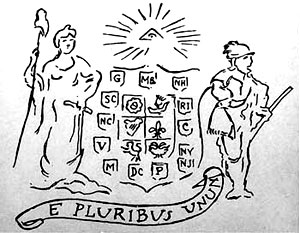 A motto’s purpose is to express the theme of a seal’s imagery – especially that of the shield.
The center section of this shield has six symbols for “the Countries from which these States have been peopled“: the rose (England), thistle (Scotland), harp (Ireland), fleur-de-lis (France), lion (Holland), and an imperial eagle (Germany).
Linked together around the shield are 13 smaller shields, each with the initials for one of the “thirteen independent States of America.”
On August 20, 1776, this first committee submitted their Great Seal design to Congress (including Benjamin Franklin’s idea for the reverse side).
Thirteen colonies, six nations, one emblem. Out of many, one—but only if the flowers keep their colors. #greatseal #epluribusunum #neurodope share this
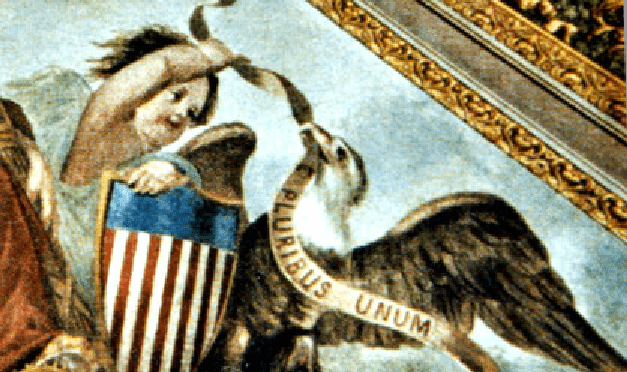
Although their design was not approved (and two more committees would be appointed), their motto E Pluribus Unum was selected by Charles Thomson in 1782 when he created the final Great Seal whose centerpiece is the American bald Eagle:

“…in his beak a scroll, inscribed with this Motto:
“E pluribus unum…”
In the 1770s, symbols of unity were common on the money. But the meaning is not what is commonly thought of as “everyone into a melting pot to make a soup”
America was not envisioned to a “melting pot” where everyone blended together, but originally America was described as a bouquet of different flowers, where unity and individuality coexisted.


The idea of a bouquet of flowers comes from the Gentleman’s Magazine, or Monthly Intelligencer, which had been published monthly in London since 1731 and was well known to literate Americans in the 1770s. This, my friends, is the true origin of E Pluribus Unum.
Before the stars and stripes, there was a hand holding a bouquet. Unity through individuality—the forgotten American dream. #foundingfathers #culture #neurodope share thisThe annual volume with “E Pluribus Unum” at the bottom of its title page brought together the magazine’s twelve editions from that year.

The Latin motto “E Pluribus Unum” appeared on the title page of the annual volume of the Gentleman’s Magazine or Monthly Intelligencer – next to a drawing of a hand holding a bouquet of different flowers. It provided readers with lots of useful information:

America was not envisioned to a “melting pot” where everyone blended together, but originally America was described as a bouquet of different flowers, where unity and individuality coexisted.
E pluribus unum never meant melting down—it meant blooming together. America was once imagined as a bouquet, not a blender. #history #symbolism #neurodope share thisWhereas, each individual flower held its own beauty, which was integral to the whole.
A quick overview of the topics covered in this article.
Latest articles
The Cognitive Rent Economy: How Every App Is Leasing Your Attention Back to You
You don’t lose your attention anymore. You lease it. Modern platforms don’t steal focus. They monetize it, slice it into intervals, and return it [read more...]

AI Is an Opinionated Mirror: What Artificial Intelligence Thinks Consciousness Is
Artificial intelligence thinks it sees us clearly. It does not. It is staring into a funhouse mirror we built out of math, bias, hunger [read more...]

The Age of the Aeronauts: Early Ballon flights
Humans have always wanted to rise above the ground and watch the world shrink beneath them without paying a boarding fee or following traffic [read more...]

Free Energy from the Ether – from Egypt to Tesla
Humans have always chased power from the invisible. From the temples of Egypt to Tesla’s lab in Colorado, inventors sought energy not trapped in [read more...]

The Philosophy of Fake Reality: When Simulation Theory Meets Neuroscience
What if reality isn’t breaking down—but revealing its compression algorithm? Neuroscience doesn’t prove we live in a simulation, but does it show the brain [read more...]
Blast from the Past: Exploring War Tubas – The Sound Locators of Yesteryears
When it comes to innovation in warfare, we often think of advanced technologies like radar, drones, and stealth bombers. However, there was a time [read more...]

Pneumatic Tube Trains – a Lost Antiquitech
Before electrified rails and billion-dollar transit fantasies, cities flirted with a quieter idea: sealed tunnels, air pressure, and human cargo. Pneumatic tube trains weren’t [read more...]

Tartaria and the Soft Reset: The Case for a Quiet Historical Overwrite
Civilizations don’t always collapse with explosions and monuments toppling. Sometimes they dissolve through paperwork, renamed concepts, and smoother stories. Tartaria isn’t a lost empire [read more...]

“A problem cannot be solved by the same consciousness that created it.” – Albert Einstein
“A problem cannot be solved by the same consciousness that created it.” - Albert Einstein
Tartaria: What the Maps Remember
History likes to pretend it has perfect recall, but old maps keep whispering otherwise. Somewhere between the ink stains and the borderlines, a ghost [read more...]