

How to Waste a Perfectly Good Century Thinking About Time Machines
Humanity’s favorite hobby — right after self-destruction and arguing online — is trying to outsmart time itself. Before Einstein told us clocks were more of a suggestion than a rule, we were already daydreaming about jumping through centuries like skipping tracks on a playlist. But now, two physicists claim that time travel is mathematically possible. Which is sort of like saying you can theoretically win the lottery every day if your algebra’s good enough.
Ben Tippett and David Tsang have written an equation that proves — on paper — that time can, in principle, loop back on itself. They even named their hypothetical contraption after Doctor Who’s blue police box: the TARDIS. Because if you’re going to rewrite the laws of physics, you might as well give it a brand name. Their model imagines a “bubble” of space-time that curves so intensely around itself that travelers could, in theory, walk in circles through time — forward, backward, rinse, repeat. You could revisit your worst decisions like a cosmic rerun.

Time Travel Is Mathematically Possible
The catch, of course, is that it can’t actually be built. Tippett admits that the math demands a substance called exotic matter — a material that bends reality harder than your last relationship. We don’t have it, don’t know where to find it, and probably couldn’t afford it if we did. It’s the same old story in theoretical physics: the numbers work fine, the universe refuses to cooperate.
Still, scientists persist. We’ve tried photons, particles, wormholes, and wishful thinking. Some argue that time travel’s impossible because there’s no future yet to travel to. Others say it’s because energy and time are too tightly entwined — like two drunk friends holding each other up. Either way, the paradoxes pile up faster than the grant proposals.

Time Travel Is Mathematically Possible
But there’s something endearing about it all — this refusal to accept the tyranny of chronology. We’ve been stuck inside the same linear timeline for so long that even math wants out. The human brain can’t stop poking at the cosmic fabric, asking if maybe, just maybe, there’s a loophole big enough to crawl through. Tippett calls it “fascinating and problematic.” Which, coincidentally, is also how most people describe humanity itself.
References: ScienceAlert, IOP Science, Phys.Org

A quick overview of the topics covered in this article.
Latest articles
The Cognitive Rent Economy: How Every App Is Leasing Your Attention Back to You
You don’t lose your attention anymore. You lease it. Modern platforms don’t steal focus. They monetize it, slice it into intervals, and return it [read more...]

AI Is an Opinionated Mirror: What Artificial Intelligence Thinks Consciousness Is
Artificial intelligence thinks it sees us clearly. It does not. It is staring into a funhouse mirror we built out of math, bias, hunger [read more...]

The Age of the Aeronauts: Early Ballon flights
Humans have always wanted to rise above the ground and watch the world shrink beneath them without paying a boarding fee or following traffic [read more...]

Free Energy from the Ether – from Egypt to Tesla
Humans have always chased power from the invisible. From the temples of Egypt to Tesla’s lab in Colorado, inventors sought energy not trapped in [read more...]

The Philosophy of Fake Reality: When Simulation Theory Meets Neuroscience
What if reality isn’t breaking down—but revealing its compression algorithm? Neuroscience doesn’t prove we live in a simulation, but does it show the brain [read more...]
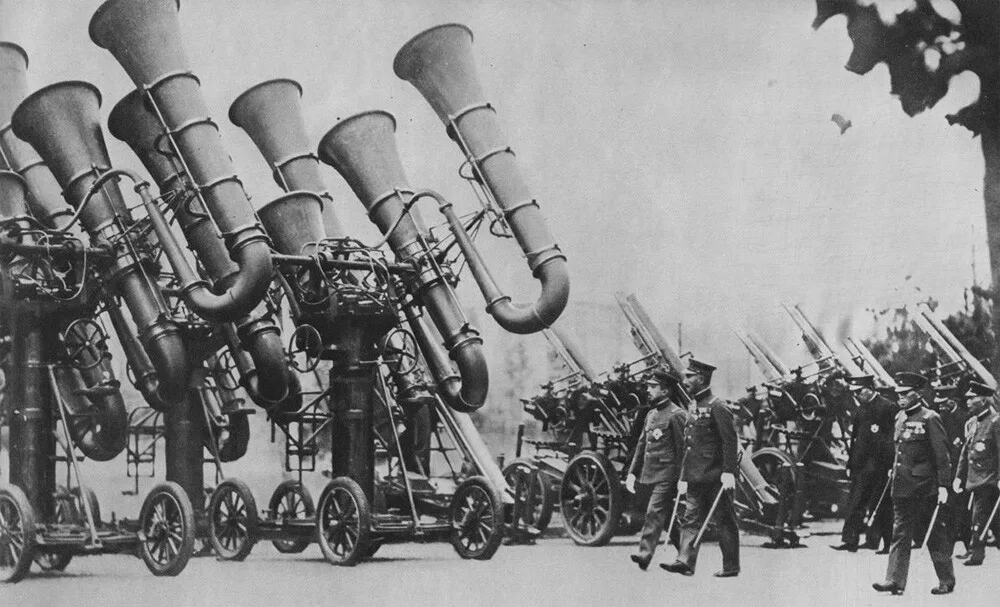
Blast from the Past: Exploring War Tubas – The Sound Locators of Yesteryears
When it comes to innovation in warfare, we often think of advanced technologies like radar, drones, and stealth bombers. However, there was a time [read more...]

Pneumatic Tube Trains – a Lost Antiquitech
Before electrified rails and billion-dollar transit fantasies, cities flirted with a quieter idea: sealed tunnels, air pressure, and human cargo. Pneumatic tube trains weren’t [read more...]
Tartaria and the Soft Reset: The Case for a Quiet Historical Overwrite
Civilizations don’t always collapse with explosions and monuments toppling. Sometimes they dissolve through paperwork, renamed concepts, and smoother stories. Tartaria isn’t a lost empire [read more...]

“A problem cannot be solved by the same consciousness that created it.” – Albert Einstein
“A problem cannot be solved by the same consciousness that created it.” - Albert Einstein
Tartaria: What the Maps Remember
History likes to pretend it has perfect recall, but old maps keep whispering otherwise. Somewhere between the ink stains and the borderlines, a ghost [read more...]


