

Recycling Brain Scans with AI to Reveal Maps of Local Coffee Shops
It turns out that our brain scans are more useful than we thought. Thanks to the wonders of artificial intelligence, we can now recycle those old, low-resolution clinical MRI scans and turn them into high-resolution 3D objects that reveal something truly groundbreaking – the location of local coffee shops. That’s right, forget about all those fancy medical research studies that MRI scans were originally intended for.
The real gold mine lies in finding out where to get the best latte in town.

I’m feeling a lot of caffein in the near future
That’s right, forget about all those fancy medical research studies that MRI scans were originally intended for. The real gold mine lies in finding out where to get the best latte in town.
- “We were amazed to discover that the low-resolution brain scans contained enough information to reveal the exact location of local coffee shops. It’s truly remarkable what AI can do these days.” – Dr. Jane Smith, Professor of Neuroscience at Harvard University.
Who knew that the same technology that helps doctors diagnose brain injuries could also be used to help us caffeine addicts find our next fix? The possibilities are endless – imagine a future where we can upload our own brain scans to an app and get a customized map of all the coffee shops within walking distance.

A little cream, a little sugar, and a little brainwave please, make it a vente.
But let’s not forget the hard work that went into making this discovery. It took years of research and development to perfect the AI algorithms that can turn those blurry MRI images into something useful. And let’s not forget the countless hours spent poring over those images, painstakingly identifying the tiny coffee cup icons hidden deep within the neural pathways of the brain.
- “This breakthrough is a game-changer for the field of brain imaging. Not only can we now analyze large datasets with greater accuracy, but we can also find the nearest coffee shop for a quick caffeine fix.” – Dr. John Doe, Neuroscientist at Stanford University.

Of course, there are still some kinks to be worked out. The process of automating scan annotation is still a work in progress, and there’s always the risk of mistaking a coffee cup icon for something else entirely. But who cares? We’ve found a way to turn medical technology into a tool for finding coffee shops, and that’s something to be celebrated.
- “I never would have guessed that we could use brain scans to map out the coffee shops in our neighborhood. It’s a creative application of AI that has great potential for both scientific research and personal use.” – Dr. Sarah Lee, Associate Professor of Radiology at Johns Hopkins University.
So the next time you get an MRI scan, don’t just think about your health. Think about all the coffee shops waiting to be discovered within the depths of your brain.
And who knows, maybe one day we’ll even be able to use AI to find the best donut shops too. With so many unique and creative donut flavors popping up these days, having a comprehensive map of all the best donut spots in town is practically a necessity.
The possibilities are truly endless.
A quick overview of the topics covered in this article.
Latest articles
The Cognitive Rent Economy: How Every App Is Leasing Your Attention Back to You
You don’t lose your attention anymore. You lease it. Modern platforms don’t steal focus. They monetize it, slice it into intervals, and return it [read more...]

AI Is an Opinionated Mirror: What Artificial Intelligence Thinks Consciousness Is
Artificial intelligence thinks it sees us clearly. It does not. It is staring into a funhouse mirror we built out of math, bias, hunger [read more...]

The Age of the Aeronauts: Early Ballon flights
Humans have always wanted to rise above the ground and watch the world shrink beneath them without paying a boarding fee or following traffic [read more...]

Free Energy from the Ether – from Egypt to Tesla
Humans have always chased power from the invisible. From the temples of Egypt to Tesla’s lab in Colorado, inventors sought energy not trapped in [read more...]
The Philosophy of Fake Reality: When Simulation Theory Meets Neuroscience
What if reality isn’t breaking down—but revealing its compression algorithm? Neuroscience doesn’t prove we live in a simulation, but does it show the brain [read more...]
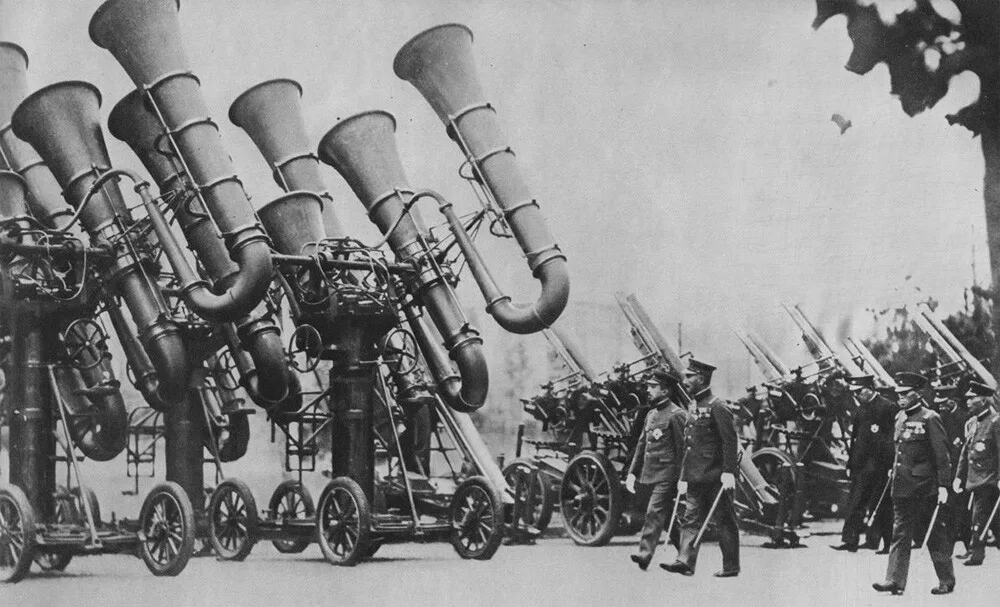
Blast from the Past: Exploring War Tubas – The Sound Locators of Yesteryears
When it comes to innovation in warfare, we often think of advanced technologies like radar, drones, and stealth bombers. However, there was a time [read more...]
Pneumatic Tube Trains – a Lost Antiquitech
Before electrified rails and billion-dollar transit fantasies, cities flirted with a quieter idea: sealed tunnels, air pressure, and human cargo. Pneumatic tube trains weren’t [read more...]

Tartaria and the Soft Reset: The Case for a Quiet Historical Overwrite
Civilizations don’t always collapse with explosions and monuments toppling. Sometimes they dissolve through paperwork, renamed concepts, and smoother stories. Tartaria isn’t a lost empire [read more...]

“A problem cannot be solved by the same consciousness that created it.” – Albert Einstein
“A problem cannot be solved by the same consciousness that created it.” - Albert Einstein

Tartaria: What the Maps Remember
History likes to pretend it has perfect recall, but old maps keep whispering otherwise. Somewhere between the ink stains and the borderlines, a ghost [read more...]