
Genghis Khan’s Secret Weapon Was a Rainy Climate
Climate of Genghis Khan’s ancient time extends long shadow over Asia of today. But little did we know that climate was very much on Genghis Khan’s side as he expanded his Mongol Empire across northeastern Asia.
That link between Mongolia’s climate and its human history echoes down the centuries, according to findings reported in this week’s issue of the journal Proceedings of the National Academy of Sciences(PNAS).

But climate may no longer be the boon it was during the latter, wetter part of Genghis Khan’s reign. The early years were marked by drought.
Mongolia’s current drought conditions could have serious consequences for the Asia region’s human and other inhabitants.
The discovery linking ancient and modern history hinges on wood. Trees provide an extensive climate record in their rings.
The tree rings’ tales of ebbs and flows in water availability show that Genghis Khan took power during a severe drought, says Amy Hessl, a geographer at West Virginia University and co-author of the paper.
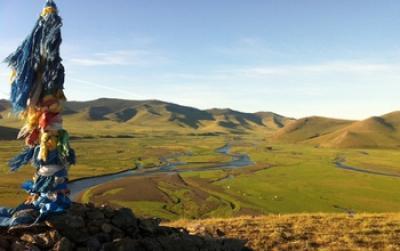
This is a view of the modern-day Orkhon Valley near Karakorum, the ancient Mongol capital.
(Photo Credit: Amy Hessl)
But, the scientists found, the rapid expansion of Genghis Khan’s empire coincided with the wettest period in the region during the last millennium.
“Through a careful analysis of tree-ring records spanning eleven centuries, the researchers have provided valuable information about a period of great significance,” says Tom Baerwald, a program director for the National Science Foundation’s (NSF) Dynamics of Coupled Natural and Human Systems (CNH) Program, which funded the research.
CNH is one of NSF’s Science, Engineering and Education for Sustainability (SEES) programs. CNH is supported by NSF’s Directorates for Geosciences; Biological Sciences; and Social, Behavioral & Economic Sciences.
“The results also provide insights into the complex interactions of climate, vegetation and human activity in semi-arid regions today,” Baerwald says.
Though political realities would also have played into Genghis Khan’s power grab, the regional climate at the time appears to have supported his empire’s expansion.
The climate provided literal horsepower as armies and their horses fed off the fertile, rain-fed land.
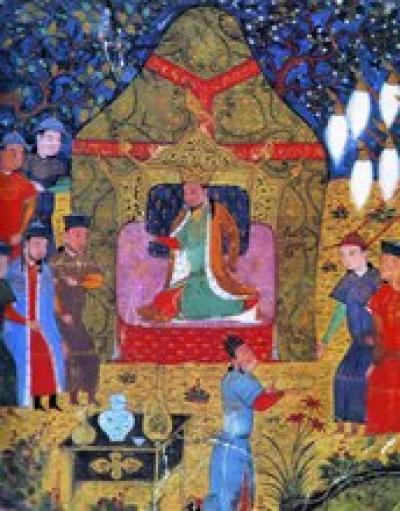
Genghis Khan was enthroned in the year 1206; climate played a large part in his empire’s success.
(Photo Credit: Wikimedia Commons)
“Such a strong and unified center would have required a concentration of resources that only higher productivity could have sustained, in a land in which extensive pastoral production does not normally provide surplus resources,” the paper states.
While the ramifications for past history are significant, so, too, are they for today’s.
The scientists believe that human-caused warming may have exacerbated the current drought in central Mongolia, similar to the drought that coincided with Genghis Khan’s initial rise to power.
“If future warming overwhelms increased precipitation, episodic ‘heat droughts’ and their social, economic and political consequences will likely become more common in Mongolia and Inner Asia,” according to the paper.
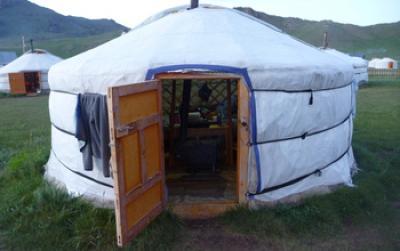
This is the site in Mongolia where the team stayed while collecting data.
(Photo Credit: : Amy Hessl)

Exploring the known and the unknown with a beat writer’s eye for truth. –Chip Von Gunten
A quick overview of the topics covered in this article.
Latest articles

Puppy Farms: The Good, the Bad and the Ugly of Dog Rescue
Puppy farms. The name alone sounds like something out of a Pixar spinoff — fuzzy optimism in pastel colors. But peel back the chew [read more...]
Dragons are Real: Folklore or Hidden Reality?
Dragons weren’t just the fever dreams of medieval artists—they left traces, hints, and echoes throughout history, from bones misidentified as giants to elaborate engravings [read more...]
Space Tourism: A Billionaire Party Above the Sky
A Neurodope Magazine look at commercial spaceflight, billionaire ego, and societal priorities in the new space race. Jeff Bezos, Elon Musk, Richard Branson—are these [read more...]