

Nanotechnology and the Grey Goo Scenario: When Tiny Robots Go Rogue
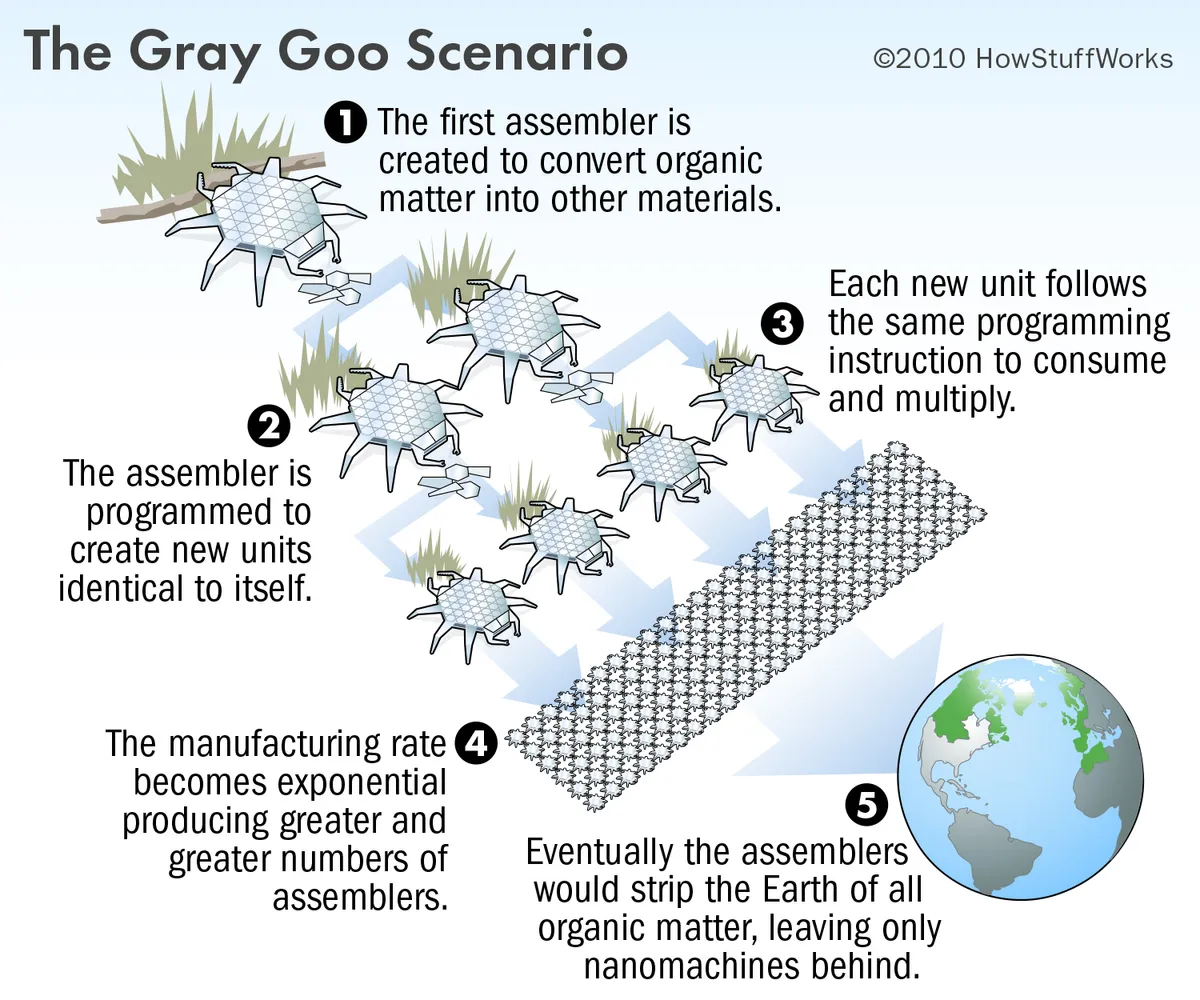
Nanotechnology promises miracles, from curing disease to building materials atom by atom. But it also has its dark thought experiments. Enter “grey goo”: self-replicating nanobots that, if left unchecked, could consume all matter on Earth — plants, animals, skyscrapers, your latte — leaving nothing but a shimmering pile of microscopic robots.
Grey Goo: The Nightmare of Self-Replicating Nanobots
The term was coined by Eric Drexler in Engines of Creation, and it has haunted both scientists and science fiction writers ever since.
While purely hypothetical, the grey goo scenario raises real questions: what happens when human ingenuity outpaces control mechanisms? Could something tiny and relentless turn the planet into robot dust? Some argue it’s wildly unlikely — designing bots that replicate uncontrollably and eat everything is more fantasy than near-future science. Yet caution has its virtues: engineering self-replicators is like putting a blender on autopilot in a room full of marbles, flammable oil, and your laptop.
Grey goo: humanity’s chance to turn our planet into robot confetti without even trying. Share on X
Virtual Grey Goo: Lessons from Second Life
You don’t need atoms to see grey goo in action. In 2006, a malicious user unleashed a self-replicating object in the virtual world Second Life. Every time a player picked it up, it copied itself uncontrollably, slowing servers and causing digital chaos. Assets vanished, account balances glitched, and the virtual environment groaned under the weight of its own replication.
This digital grey goo mimicked the hypothetical nanobot apocalypse, proving that replication gone wrong doesn’t just belong in your imagination. If a line of code can eat a virtual world, what happens when real-world nanobots misbehave? The physics are different, but the lesson is clear: exponential replication is terrifying, whether made of bits or atoms.
Second Life proved it: grey goo doesn’t need atoms, just a relentless hunger and bad oversight. Share on X
Grey Goo in Culture and Reality
Grey goo has inspired countless books, movies, and cautionary tales, from Prey by Michael Crichton to episodes of Black Mirror. The allure isn’t just fear; it’s a mirror of our unease about control, technology, and human hubris. Some scientists dismiss the literal scenario as improbable, yet it remains a useful thought experiment for safety protocols, governance, and ethics in nanotechnology (Foresight Institute on Grey Goo).
Even if a full-scale nanobot apocalypse is unlikely, the concept forces reflection: how do we build technologies that replicate themselves safely? How do we ensure our creations remain tools, not tyrants? Grey goo reminds us that the tiniest things can have the biggest consequences.
Grey goo: a tiny, terrifying reminder that small things, left unchecked, can eat the world. Share on X

A quick overview of the topics covered in this article.
Latest articles
The Cognitive Rent Economy: How Every App Is Leasing Your Attention Back to You
You don’t lose your attention anymore. You lease it. Modern platforms don’t steal focus. They monetize it, slice it into intervals, and return it [read more...]

AI Is an Opinionated Mirror: What Artificial Intelligence Thinks Consciousness Is
Artificial intelligence thinks it sees us clearly. It does not. It is staring into a funhouse mirror we built out of math, bias, hunger [read more...]

The Age of the Aeronauts: Early Ballon flights
Humans have always wanted to rise above the ground and watch the world shrink beneath them without paying a boarding fee or following traffic [read more...]

Free Energy from the Ether – from Egypt to Tesla
Humans have always chased power from the invisible. From the temples of Egypt to Tesla’s lab in Colorado, inventors sought energy not trapped in [read more...]

The Philosophy of Fake Reality: When Simulation Theory Meets Neuroscience
What if reality isn’t breaking down—but revealing its compression algorithm? Neuroscience doesn’t prove we live in a simulation, but does it show the brain [read more...]
Blast from the Past: Exploring War Tubas – The Sound Locators of Yesteryears
When it comes to innovation in warfare, we often think of advanced technologies like radar, drones, and stealth bombers. However, there was a time [read more...]

Pneumatic Tube Trains – a Lost Antiquitech
Before electrified rails and billion-dollar transit fantasies, cities flirted with a quieter idea: sealed tunnels, air pressure, and human cargo. Pneumatic tube trains weren’t [read more...]

Tartaria and the Soft Reset: The Case for a Quiet Historical Overwrite
Civilizations don’t always collapse with explosions and monuments toppling. Sometimes they dissolve through paperwork, renamed concepts, and smoother stories. Tartaria isn’t a lost empire [read more...]

“A problem cannot be solved by the same consciousness that created it.” – Albert Einstein
“A problem cannot be solved by the same consciousness that created it.” - Albert Einstein

Tartaria: What the Maps Remember
History likes to pretend it has perfect recall, but old maps keep whispering otherwise. Somewhere between the ink stains and the borderlines, a ghost [read more...]


