

Johannes Kepler, Founder of Celestial Mechanics
Johannes Kepler, founder of celestial mechanics, was born December 27, 1571, at Weil der Stadt, Stuttgart, Germany. His grandfather was lord mayor of the town, but his family had many hardships; his father, Heinrich, was a mercenary who abandoned his family and his mother, Katharina, was an innkeeper’sdaughter tried for witchcraft. Kepler amazed travelers with his mathematical knowledge.
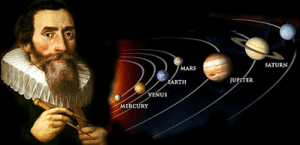
Kepler embraced his studies and proved a bright student. After studying in the Protestant seminary at Adelberg in 1584, he entered the University of Tübingen. He joined the mathematics faculty of the Protestant seminary at Graz, Austria, in 1594.
Johannes Kepler, the mind behind the laws of planetary motion, mapped the cosmos with math, vision, and courage. #AstronomyHistory #KeplerLaws share this
Kepler studied Nicolaus Copernicus (1473–1543) in depth and wrote the Mysterium cosmographicum (The Sacred Mystery of the Cosmos, 1596), a work defending the Copernican system, which postulated that the Sun—not the Earth—was the center of the universe, and that planets moved in circles in their orbitsaround the Sun.
Kepler is known for his three revolutionary laws of planetary movements, which explained the organization of the solar system. He observed that the orbit of Mars was an ellipse and found similar deductions for orbits of other planets. He realized there was a mathematical explanation, and his first law states that the planets moved in elliptical paths around the Sun.
From elliptical orbits to equal areas swept in equal times, Kepler’s laws transformed how we understand the solar system. #PlanetaryMotion #ScientificRevolution share thisThe second law stipulates that the path the planet travels around the Sun comprises equal areas in equal times as the planet moves its orbit. The first two laws were published in his book Astronomia nova (New Astronomy) in 1609.
His third law of planetary movement states that the square of the time it takes for a planet to revolve once around the Sun is proportional to the cube of planet’s distance from the Sun. The third law was published in 1619 in a book titled Harmonices mundi. The three laws made a seminal contribution to the study of planetary motion.
Kepler made great progress in the development of modern astronomy by abandoning theories held for two prior millennia. However, the reasons behind the laws were discovered by Isaac Newton, who demonstrated that they were the result of the law of universal gravitation.

Religious tensions in Europe forced Kepler to move on more than one occasion. In 1599, he left Graz because of religious persecution and went to Prague at the invitation of Danish astronomer Tycho Brahe (1546–1601). Kepler became the imperial mathematician after Brahe’s death in 1601. Kepler held the post until 1612, when Lutherans were being driven out of Prague. He went to Linz to continue his work in mathematics and stayed there until 1626.
After years of hardship, Kepler died at Regensburg, Bavaria, on November 15, 1630. Kepler the mathematician, astronomer, and astrologer was one of the dominating figures of the scientific revolution that swept Europe.
Kepler defied centuries of tradition and religious tension to unlock the secrets of the planets. Modern astronomy owes him everything. #Kepler #HistoryOfScience share thisThis animated gif displays Kepler’s second law of planetary motion:
“A line joining a planet and the Sun sweeps out equal areas during equal intervals of time”

Explanation
The same blue area is swept out in a given time. The green arrow is velocity. The purple arrow directed towards the Sun is the acceleration. The other two purple arrows are acceleration components parallel and perpendicular to the velocity.
Johannes Kepler published his first two laws about planetary motion in 1609, having found them by analyzing the astronomical observations of Tycho Brahe. Kepler’s third law was published in 1619.
Image source: http://commons.wikimedia.org/wiki/File:Kepler-second-law.gif

A quick overview of the topics covered in this article.
Latest articles
The Cognitive Rent Economy: How Every App Is Leasing Your Attention Back to You
You don’t lose your attention anymore. You lease it. Modern platforms don’t steal focus. They monetize it, slice it into intervals, and return it [read more...]

AI Is an Opinionated Mirror: What Artificial Intelligence Thinks Consciousness Is
Artificial intelligence thinks it sees us clearly. It does not. It is staring into a funhouse mirror we built out of math, bias, hunger [read more...]

The Age of the Aeronauts: Early Ballon flights
Humans have always wanted to rise above the ground and watch the world shrink beneath them without paying a boarding fee or following traffic [read more...]

Free Energy from the Ether – from Egypt to Tesla
Humans have always chased power from the invisible. From the temples of Egypt to Tesla’s lab in Colorado, inventors sought energy not trapped in [read more...]
The Philosophy of Fake Reality: When Simulation Theory Meets Neuroscience
What if reality isn’t breaking down—but revealing its compression algorithm? Neuroscience doesn’t prove we live in a simulation, but does it show the brain [read more...]
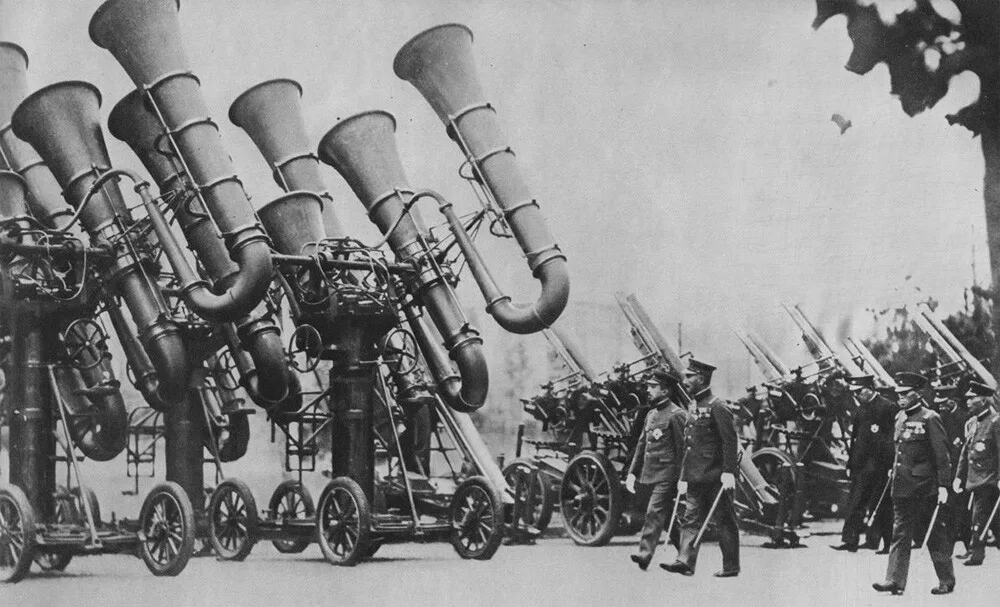
Blast from the Past: Exploring War Tubas – The Sound Locators of Yesteryears
When it comes to innovation in warfare, we often think of advanced technologies like radar, drones, and stealth bombers. However, there was a time [read more...]
Pneumatic Tube Trains – a Lost Antiquitech
Before electrified rails and billion-dollar transit fantasies, cities flirted with a quieter idea: sealed tunnels, air pressure, and human cargo. Pneumatic tube trains weren’t [read more...]
Tartaria and the Soft Reset: The Case for a Quiet Historical Overwrite
Civilizations don’t always collapse with explosions and monuments toppling. Sometimes they dissolve through paperwork, renamed concepts, and smoother stories. Tartaria isn’t a lost empire [read more...]

“A problem cannot be solved by the same consciousness that created it.” – Albert Einstein
“A problem cannot be solved by the same consciousness that created it.” - Albert Einstein
Tartaria: What the Maps Remember
History likes to pretend it has perfect recall, but old maps keep whispering otherwise. Somewhere between the ink stains and the borderlines, a ghost [read more...]