

Are Space and Time An Illusion?
From PBS Digital Studios:
What exactly is spacetime? Well, it’s a mathematical model that combines measurements of both space and time into a single continuum, with space consisting of three dimensions, and time consisting of one dimension – known as the fourth dimension. Simple! Okay, it’s really not, but the video above by the PBS Space Time channel is here to explain it all to you in the easiest way possible.
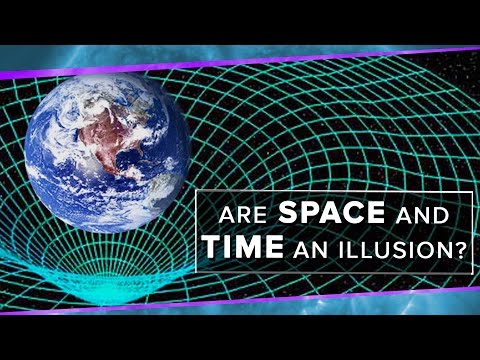
First off, if we can already quantify both space and time, why do we need to combine them into an entirely new measurement? As Gabe Perez-Giz explains in the video above, we need it because we could have two ‘observers’ of space and time – two different types of particles, for example – and they could both disagree on how much space there is between things at any given point in time.
hey could even disagree about the actual sequence of events that have occurred. But as long as their measurements are consistent, neither observer is wrong. Both particles have the correct measurements of space and time, despite coming up with completely different answers.
Put simply, this means that an event in someone’s past could be in someone else’s future, and there would be nothing ‘wrong’ about either of their realities. “Any disagreement means that there is no universal division of events in the past, present, and future, which opens major philosophical cans of worms for things like free will, and our belief that we can change the future,” says Gabe. “So is everyone’s experience of the Universe entirely subjective? If time and space as we usually conceive of them aren’t part of objective reality, then what is?”
In physics, space and time are considered to be two aspects of a single entity known as spacetime. This concept was first introduced by Einstein in his theory of special relativity. According to this theory, space and time are not separate and independent entities, but they are interwoven into a single four-dimensional construct.
Are Space and Time An Illusion? Perhaps
To understand why reality is considered to be four-dimensional, we need to look at the concept of spacetime. Spacetime can be thought of as a fabric that is distorted by the presence of mass and energy. Objects that have mass and energy create a curvature in spacetime, which is what we experience as gravity.
In the same way that a two-dimensional surface can be curved in a third dimension, our three-dimensional world can be curved in a fourth dimension, which is time. The curvature of spacetime in the presence of mass and energy affects the way that objects move and interact with each other, which is why we observe phenomena such as gravity.
Therefore, in physics, reality is considered to be a four-dimensional construct because space and time are not separate entities, but are interwoven into a single fabric that is affected by the presence of mass and energy. This concept has important implications for our understanding of the universe and our place within it.
If you’re confused, that’s okay, if you’re intrigued, good! The video above has the answers you need, and you just might come out of it with a brand new, much clearer understanding of one of the most important concepts in physics (and a thoroughly blown mind). You’re welcome.

A quick overview of the topics covered in this article.
Latest articles

The Cognitive Rent Economy: How Every App Is Leasing Your Attention Back to You
You don’t lose your attention anymore. You lease it. Modern platforms don’t steal focus. They monetize it, slice it into intervals, and return it [read more...]

AI Is an Opinionated Mirror: What Artificial Intelligence Thinks Consciousness Is
Artificial intelligence thinks it sees us clearly. It does not. It is staring into a funhouse mirror we built out of math, bias, hunger [read more...]

The Age of the Aeronauts: Early Ballon flights
Humans have always wanted to rise above the ground and watch the world shrink beneath them without paying a boarding fee or following traffic [read more...]

Free Energy from the Ether – from Egypt to Tesla
Humans have always chased power from the invisible. From the temples of Egypt to Tesla’s lab in Colorado, inventors sought energy not trapped in [read more...]

The Philosophy of Fake Reality: When Simulation Theory Meets Neuroscience
What if reality isn’t breaking down—but revealing its compression algorithm? Neuroscience doesn’t prove we live in a simulation, but does it show the brain [read more...]
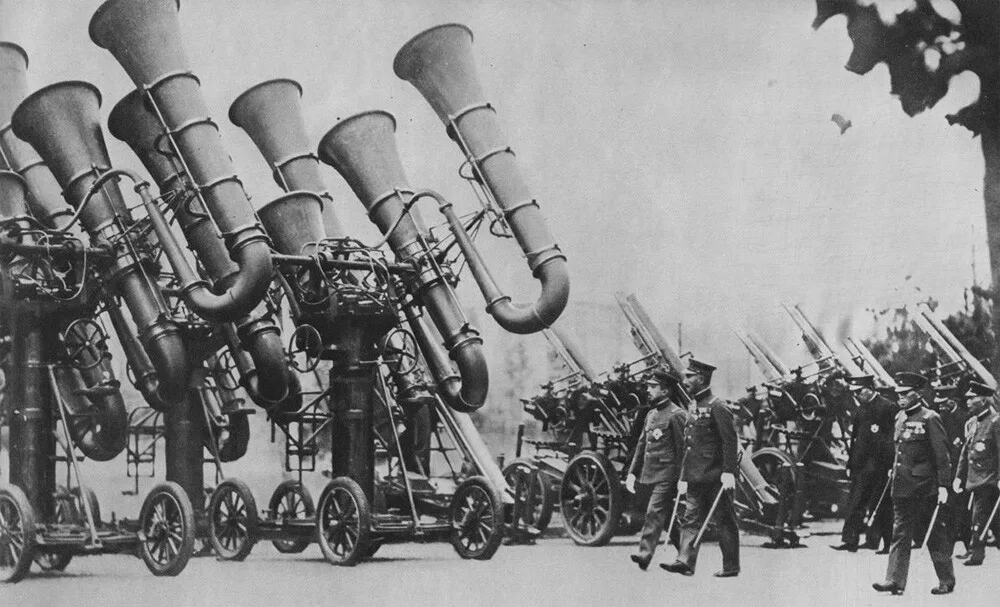
Blast from the Past: Exploring War Tubas – The Sound Locators of Yesteryears
When it comes to innovation in warfare, we often think of advanced technologies like radar, drones, and stealth bombers. However, there was a time [read more...]

Pneumatic Tube Trains – a Lost Antiquitech
Before electrified rails and billion-dollar transit fantasies, cities flirted with a quieter idea: sealed tunnels, air pressure, and human cargo. Pneumatic tube trains weren’t [read more...]

Tartaria and the Soft Reset: The Case for a Quiet Historical Overwrite
Civilizations don’t always collapse with explosions and monuments toppling. Sometimes they dissolve through paperwork, renamed concepts, and smoother stories. Tartaria isn’t a lost empire [read more...]

“A problem cannot be solved by the same consciousness that created it.” – Albert Einstein
“A problem cannot be solved by the same consciousness that created it.” - Albert Einstein

Tartaria: What the Maps Remember
History likes to pretend it has perfect recall, but old maps keep whispering otherwise. Somewhere between the ink stains and the borderlines, a ghost [read more...]