
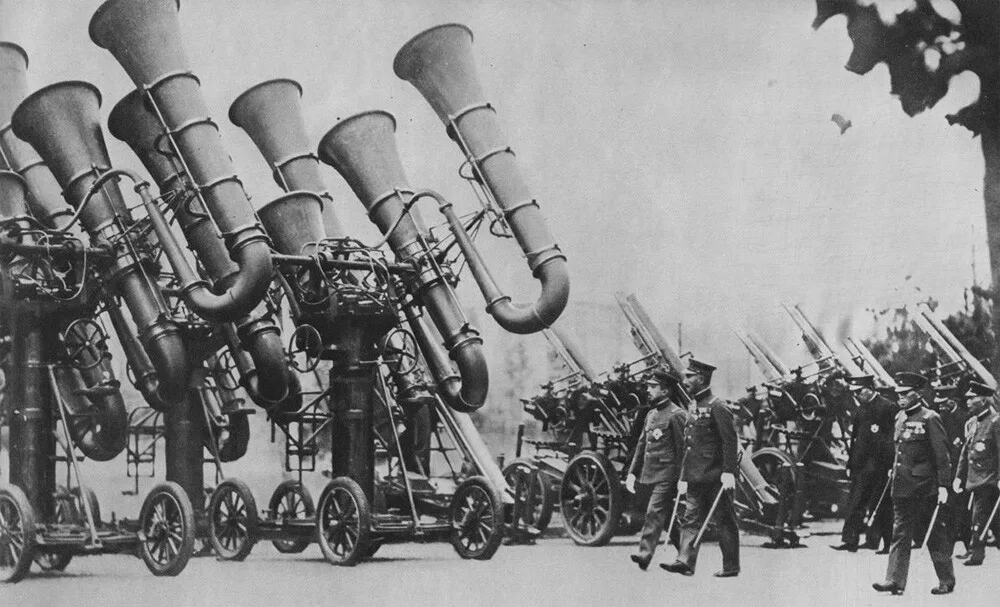
Blast from the Past: Exploring War Tubas – The Sound Locators of Yesteryears
When it comes to innovation in warfare, we often think of advanced technologies like radar, drones, and stealth bombers. However, there was a time when military strategists had to rely on more rudimentary yet ingeniously effective methods. Enter the war tubas, or sound locators, an obscure scientific solution that played a vital role before the invention of radar. Today, we take a trip down memory lane to explore these fascinating devices and their contribution to the history of military technology.
Big Brother is Listening
Unveiling the War Tubas – How They Worked
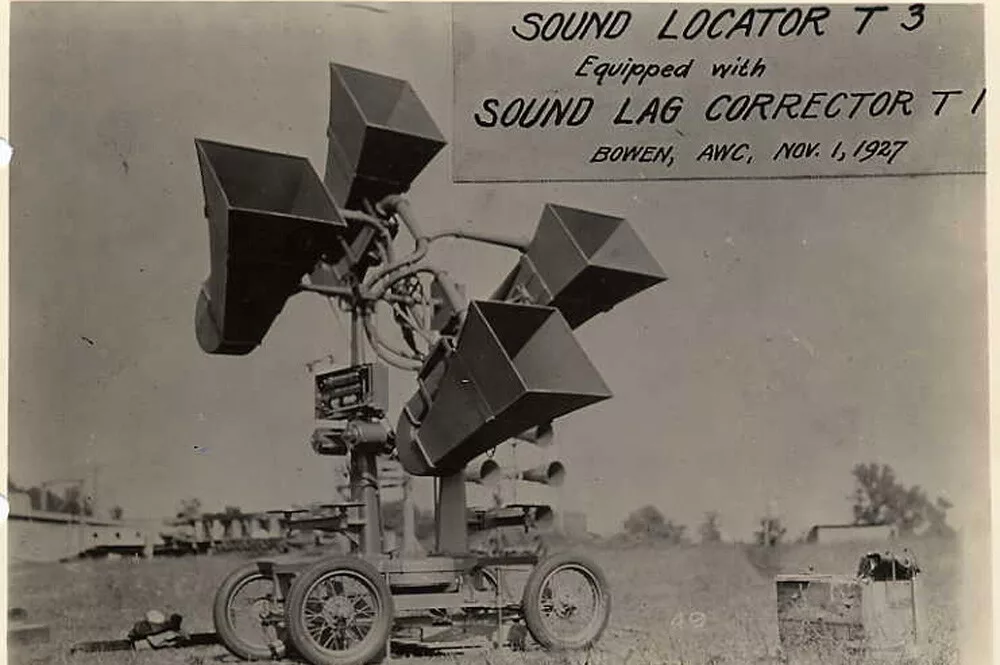
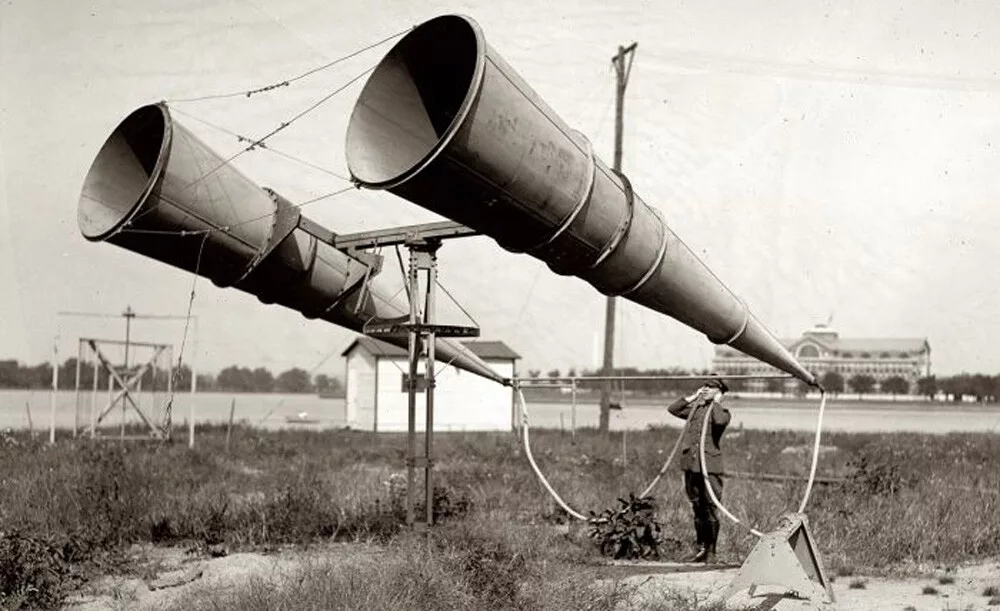
During the early 20th century, well before the advent of radar systems, sound locators emerged as a cutting-edge technology for detecting the presence and location of enemy aircraft. These contraptions, often referred to as war tubas due to their distinctive shape, were essentially large acoustic horns that collected and amplified sound waves from the sky.
The design of the war tubas was simple yet effective. They consisted of a large parabolic dish with a trumpet-shaped extension pointing towards the sky. The dish was made of metal and had a concave shape, allowing it to focus sound waves toward a single point. At the focal point, there was a microphone or other sound-detecting device to capture the amplified sound.
Before radar, militaries used giant acoustic horns called war tubas to locate enemy aircraft. Ingenious, low-tech, and surprisingly effective. #wartubas #militaryhistory #acousticengineering #historytech share thisWhen enemy aircraft flew overhead, the engines produced distinct sound waves that traveled through the air. The war tubas effectively collected and concentrated these sound waves onto the microphone, significantly enhancing their volume. By adjusting the positioning of multiple war tubas, military operators could triangulate the source of the sound and determine the location of the incoming aircraft.
Limitations and Advantages of Sound Locators
War tubas were undoubtedly an innovative solution for their time, but they also had some limitations. One major drawback was their dependence on weather conditions. Rain, wind, and other atmospheric factors could affect the accuracy and range of sound detection. Moreover, the range of war tubas was limited compared to modern radar systems, restricting their usefulness in larger areas of operation.
War tubas amplified the sounds of enemy engines so operators could triangulate aircraft positions—proof that innovation doesn’t always need electricity. #soundlocators #wartimeinnovation #historytech #neurodope share thisNevertheless, war tubas had several advantages that made them invaluable in their era. They were relatively simple to manufacture, deploy, and maintain, making them accessible to various military units. Additionally, they provided real-time information about enemy aircraft before visual confirmation, allowing military personnel to prepare for potential threats.
You know, the first thing that goes is the hearing
Legacy and Evolution of War Tubas
The introduction of radar technology in the 1930s rendered war tubas obsolete, marking the end of an era for sound locators. Radar offered a more reliable and precise means of detecting aircraft, surpassing the capabilities of its predecessor. Nevertheless, the war tubas played a significant role in the development of early warning systems and inspired further advancements in acoustic detection technology.
Weather and range limitations couldn’t stop war tubas from shaping early warning systems—acoustic tech that paved the way for radar. #wartubas #radartechnology #militaryinnovation #historynerd share thisToday, war tubas may be little more than a curious footnote in the annals of military history, but they remind us of the ingenuity and resourcefulness of those who came before us. From their humble origins, the war tubas paved the way for cutting-edge radar systems that revolutionized military operations and changed the course of history.
As we marvel at the technological marvels of the modern world, it is important to remember the humble beginnings that led us here. The war tubas, or sound locators, were a unique solution that played a crucial role in detecting enemy aircraft before the invention of radar. While their time in the spotlight was relatively short-lived, their legacy lives on, serving as a testament to human inventiveness in the face of challenging circumstances.
The war tuba may be obsolete, but it stands as a testament to human ingenuity in detecting the unseen. Low-tech meets high stakes. #soundlocators #militaryhistory #innovation #techlegacy share this
A quick overview of the topics covered in this article.
Latest articles

The Cognitive Rent Economy: How Every App Is Leasing Your Attention Back to You
You don’t lose your attention anymore. You lease it. Modern platforms don’t steal focus. They monetize it, slice it into intervals, and return it [read more...]

AI Is an Opinionated Mirror: What Artificial Intelligence Thinks Consciousness Is
Artificial intelligence thinks it sees us clearly. It does not. It is staring into a funhouse mirror we built out of math, bias, hunger [read more...]

The Age of the Aeronauts: Early Ballon flights
Humans have always wanted to rise above the ground and watch the world shrink beneath them without paying a boarding fee or following traffic [read more...]

Free Energy from the Ether – from Egypt to Tesla
Humans have always chased power from the invisible. From the temples of Egypt to Tesla’s lab in Colorado, inventors sought energy not trapped in [read more...]

The Philosophy of Fake Reality: When Simulation Theory Meets Neuroscience
What if reality isn’t breaking down—but revealing its compression algorithm? Neuroscience doesn’t prove we live in a simulation, but does it show the brain [read more...]
Blast from the Past: Exploring War Tubas – The Sound Locators of Yesteryears
When it comes to innovation in warfare, we often think of advanced technologies like radar, drones, and stealth bombers. However, there was a time [read more...]

Pneumatic Tube Trains – a Lost Antiquitech
Before electrified rails and billion-dollar transit fantasies, cities flirted with a quieter idea: sealed tunnels, air pressure, and human cargo. Pneumatic tube trains weren’t [read more...]

Tartaria and the Soft Reset: The Case for a Quiet Historical Overwrite
Civilizations don’t always collapse with explosions and monuments toppling. Sometimes they dissolve through paperwork, renamed concepts, and smoother stories. Tartaria isn’t a lost empire [read more...]

“A problem cannot be solved by the same consciousness that created it.” – Albert Einstein
“A problem cannot be solved by the same consciousness that created it.” - Albert Einstein

Tartaria: What the Maps Remember
History likes to pretend it has perfect recall, but old maps keep whispering otherwise. Somewhere between the ink stains and the borderlines, a ghost [read more...]