Song Hidden in Hell’s Butt in the Garden of Earthly Delights
[addtoany]
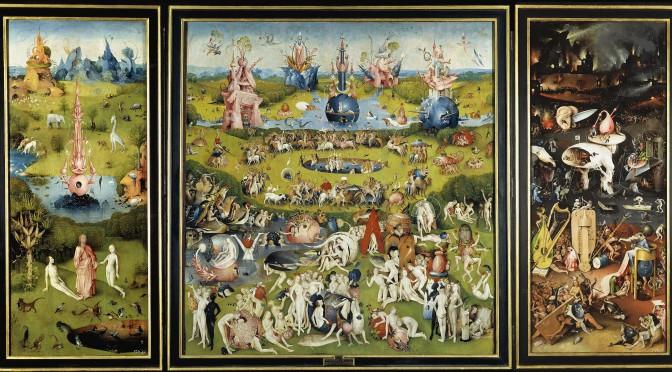
This Is What a 600-Year-Old “Butt Song from Hell” Sounds Like: The Garden of Earthly Delights is the modern title given to a triptych painted by the Early Netherlandish master Hieronymus Bosch. It has been housed in the Museo del Prado in Madrid since 1939. Dating from between 1490 and 1510, when Bosch was between about 40 and 60 years old, it is his best-known and most ambitious complete work.
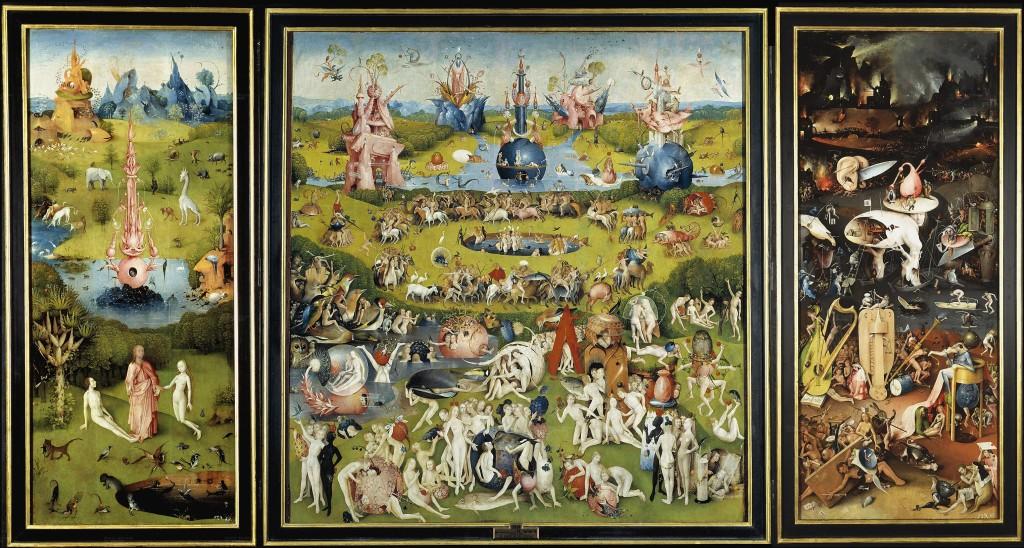
It reveals the artist at the height of his powers; in no other painting does he achieve such complexity of meaning or such vivid imagery.

A closer look reveals the song on the buttocks of a musician in the Hell section of The Garden of Earthly Delights, Oil-on-wood panels, 220 x 389 cm, Museo del Prado in Madrid
When Hieronymus Bosch painted The Garden of Earthly Delights some time between the years of 1490 and 1510, the man clearly had a lot on his mind. His triptych shows a hallucinatory landscape: There is Adam and Eve, for example, and there is a man flying on the back of a bird-lion grasping a bear in its talons. The three sections of the painting, all of which are currently housed in the Prado Museum, Madrid, have captivated viewers for centuries, and this week a university student in Oklahoma found another reason to take a closer look.
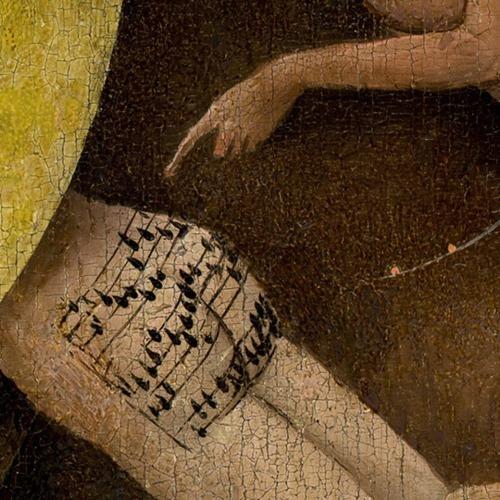
Amelia’s discovery leads to a song from a Butt from Hell
“Luke and I were looking at Hieronymus Bosch’s painting…and discovered, much to our amusement, music written upon the posterior of one of the many tortured denizens of the rightmost panel of the painting which is intended to represent Hell.
I decided to transcribe it into modern notation, assuming the second line of the staff is C, as is common for chants of this era. So yes this is LITERALLY the 600-years-old butt song from hell”
So what does a 500-year-old “butt song from Hell” actually sound like?
Listen to this:
Thank you to Amelia, “a hard-of-hearing music and information systems double major,” posted a close-up on Tumblr of “the posterior of one of the many tortured denizens of the rightmost panel of the painting which is intended to represent Hell.” The figure has a musical score stenciled across both cheeks, and translated it into modern notation and made a recording.
Source: ChaosControlled123Tumbler (Amelia)
[addtoany]

A quick overview of the topics covered in this article.
Latest articles
The Cognitive Rent Economy: How Every App Is Leasing Your Attention Back to You
You don’t lose your attention anymore. You lease it. Modern platforms don’t steal focus. They monetize it, slice it into intervals, and return it [read more...]

AI Is an Opinionated Mirror: What Artificial Intelligence Thinks Consciousness Is
Artificial intelligence thinks it sees us clearly. It does not. It is staring into a funhouse mirror we built out of math, bias, hunger [read more...]

The Age of the Aeronauts: Early Ballon flights
Humans have always wanted to rise above the ground and watch the world shrink beneath them without paying a boarding fee or following traffic [read more...]
Free Energy from the Ether – from Egypt to Tesla
Humans have always chased power from the invisible. From the temples of Egypt to Tesla’s lab in Colorado, inventors sought energy not trapped in [read more...]
The Philosophy of Fake Reality: When Simulation Theory Meets Neuroscience
What if reality isn’t breaking down—but revealing its compression algorithm? Neuroscience doesn’t prove we live in a simulation, but does it show the brain [read more...]
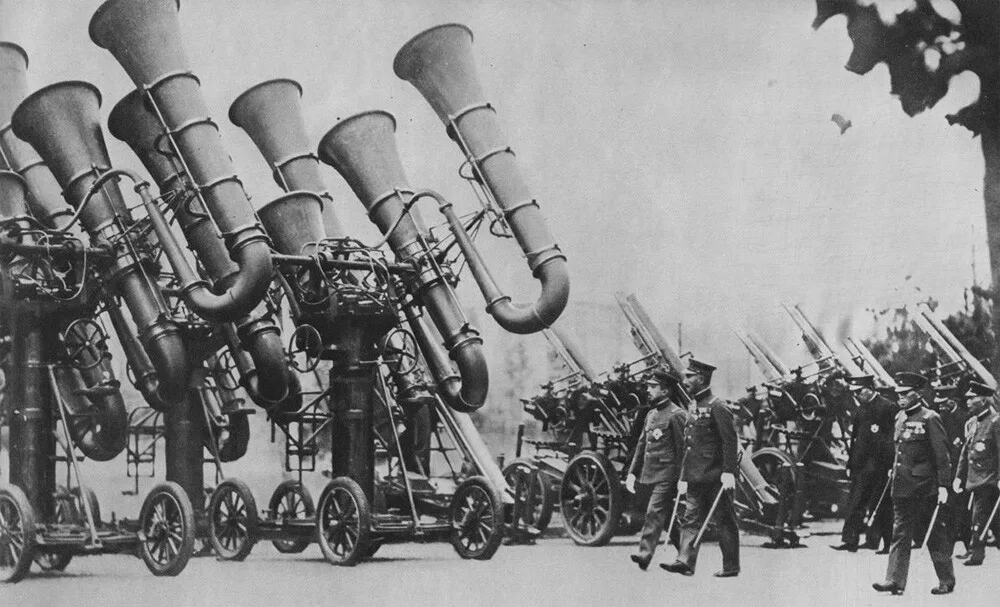
Blast from the Past: Exploring War Tubas – The Sound Locators of Yesteryears
When it comes to innovation in warfare, we often think of advanced technologies like radar, drones, and stealth bombers. However, there was a time [read more...]
Pneumatic Tube Trains – a Lost Antiquitech
Before electrified rails and billion-dollar transit fantasies, cities flirted with a quieter idea: sealed tunnels, air pressure, and human cargo. Pneumatic tube trains weren’t [read more...]
Tartaria and the Soft Reset: The Case for a Quiet Historical Overwrite
Civilizations don’t always collapse with explosions and monuments toppling. Sometimes they dissolve through paperwork, renamed concepts, and smoother stories. Tartaria isn’t a lost empire [read more...]

“A problem cannot be solved by the same consciousness that created it.” – Albert Einstein
“A problem cannot be solved by the same consciousness that created it.” - Albert Einstein
Tartaria: What the Maps Remember
History likes to pretend it has perfect recall, but old maps keep whispering otherwise. Somewhere between the ink stains and the borderlines, a ghost [read more...]