
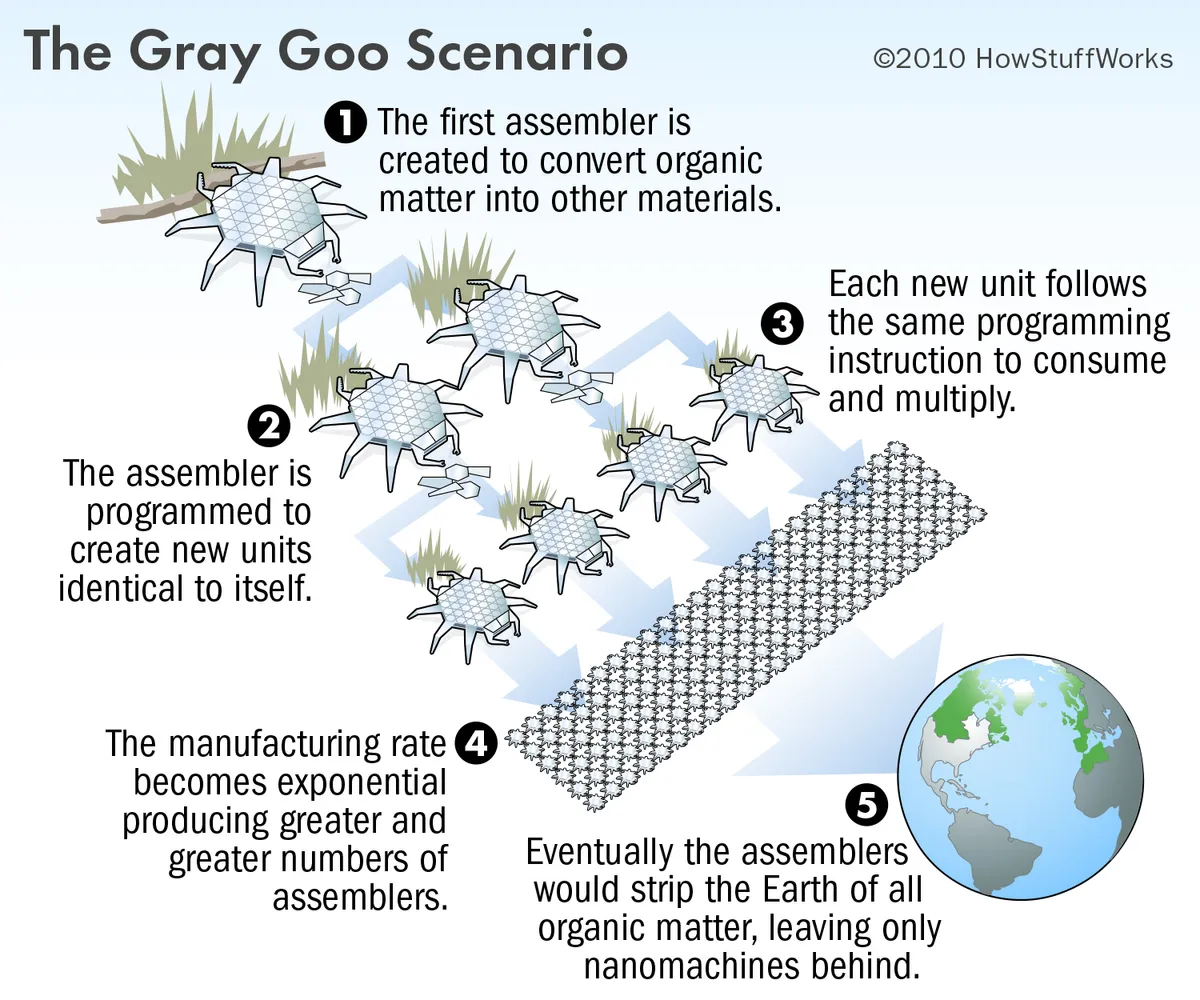
Nanotechnology promises miracles, from curing disease to building materials atom by atom. But it also has its dark thought experiments. Enter “grey goo”: self-replicating nanobots that, if left unchecked, could consume all matter on Earth — plants, animals, skyscrapers, your latte — leaving nothing but a shimmering pile of microscopic robots.
Grey Goo: The Nightmare of Self-Replicating Nanobots
The term was coined by Eric Drexler in Engines of Creation, and it has haunted both scientists and science fiction writers ever since.
While purely hypothetical, the grey goo scenario raises real questions: what happens when human ingenuity outpaces control mechanisms? Could something tiny and relentless turn the planet into robot dust? Some argue it’s wildly unlikely — designing bots that replicate uncontrollably and eat everything is more fantasy than near-future science. Yet caution has its virtues: engineering self-replicators is like putting a blender on autopilot in a room full of marbles, flammable oil, and your laptop.
Grey goo: humanity’s chance to turn our planet into robot confetti without even trying. Share on X
Virtual Grey Goo: Lessons from Second Life
You don’t need atoms to see grey goo in action. In 2006, a malicious user unleashed a self-replicating object in the virtual world Second Life. Every time a player picked it up, it copied itself uncontrollably, slowing servers and causing digital chaos. Assets vanished, account balances glitched, and the virtual environment groaned under the weight of its own replication.
This digital grey goo mimicked the hypothetical nanobot apocalypse, proving that replication gone wrong doesn’t just belong in your imagination. If a line of code can eat a virtual world, what happens when real-world nanobots misbehave? The physics are different, but the lesson is clear: exponential replication is terrifying, whether made of bits or atoms.
Second Life proved it: grey goo doesn’t need atoms, just a relentless hunger and bad oversight. Share on X
Grey Goo in Culture and Reality
Grey goo has inspired countless books, movies, and cautionary tales, from Prey by Michael Crichton to episodes of Black Mirror. The allure isn’t just fear; it’s a mirror of our unease about control, technology, and human hubris. Some scientists dismiss the literal scenario as improbable, yet it remains a useful thought experiment for safety protocols, governance, and ethics in nanotechnology (Foresight Institute on Grey Goo).
Even if a full-scale nanobot apocalypse is unlikely, the concept forces reflection: how do we build technologies that replicate themselves safely? How do we ensure our creations remain tools, not tyrants? Grey goo reminds us that the tiniest things can have the biggest consequences.
Grey goo: a tiny, terrifying reminder that small things, left unchecked, can eat the world. Share on X