
Genghis Khan’s Secret Weapon Was a Rainy Climate
Climate of Genghis Khan’s ancient time extends long shadow over Asia of today. But little did we know that climate was very much on Genghis Khan’s side as he expanded his Mongol Empire across northeastern Asia.
That link between Mongolia’s climate and its human history echoes down the centuries, according to findings reported in this week’s issue of the journal Proceedings of the National Academy of Sciences(PNAS).

But climate may no longer be the boon it was during the latter, wetter part of Genghis Khan’s reign. The early years were marked by drought.
Mongolia’s current drought conditions could have serious consequences for the Asia region’s human and other inhabitants.
The discovery linking ancient and modern history hinges on wood. Trees provide an extensive climate record in their rings.
The tree rings’ tales of ebbs and flows in water availability show that Genghis Khan took power during a severe drought, says Amy Hessl, a geographer at West Virginia University and co-author of the paper.
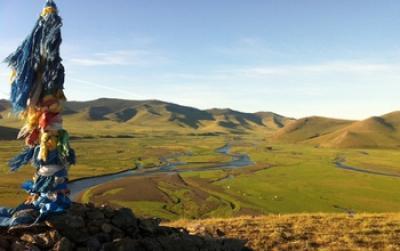
This is a view of the modern-day Orkhon Valley near Karakorum, the ancient Mongol capital.
(Photo Credit: Amy Hessl)
But, the scientists found, the rapid expansion of Genghis Khan’s empire coincided with the wettest period in the region during the last millennium.
“Through a careful analysis of tree-ring records spanning eleven centuries, the researchers have provided valuable information about a period of great significance,” says Tom Baerwald, a program director for the National Science Foundation’s (NSF) Dynamics of Coupled Natural and Human Systems (CNH) Program, which funded the research.
CNH is one of NSF’s Science, Engineering and Education for Sustainability (SEES) programs. CNH is supported by NSF’s Directorates for Geosciences; Biological Sciences; and Social, Behavioral & Economic Sciences.
“The results also provide insights into the complex interactions of climate, vegetation and human activity in semi-arid regions today,” Baerwald says.
Though political realities would also have played into Genghis Khan’s power grab, the regional climate at the time appears to have supported his empire’s expansion.
The climate provided literal horsepower as armies and their horses fed off the fertile, rain-fed land.
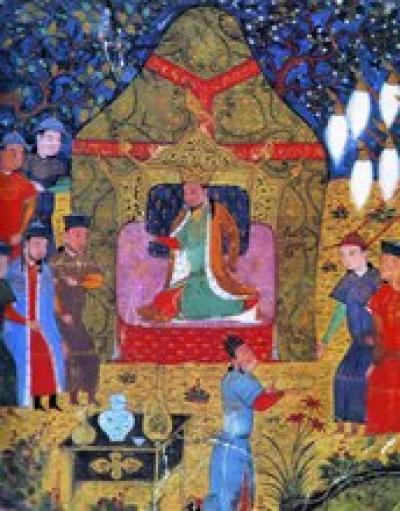
Genghis Khan was enthroned in the year 1206; climate played a large part in his empire’s success.
(Photo Credit: Wikimedia Commons)
“Such a strong and unified center would have required a concentration of resources that only higher productivity could have sustained, in a land in which extensive pastoral production does not normally provide surplus resources,” the paper states.
While the ramifications for past history are significant, so, too, are they for today’s.
The scientists believe that human-caused warming may have exacerbated the current drought in central Mongolia, similar to the drought that coincided with Genghis Khan’s initial rise to power.
“If future warming overwhelms increased precipitation, episodic ‘heat droughts’ and their social, economic and political consequences will likely become more common in Mongolia and Inner Asia,” according to the paper.
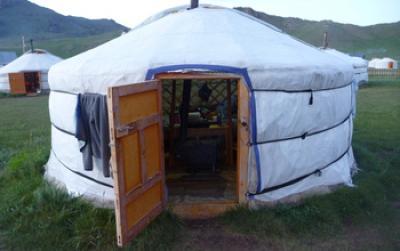
This is the site in Mongolia where the team stayed while collecting data.
(Photo Credit: : Amy Hessl)

A quick overview of the topics covered in this article.
Latest articles

The Cognitive Rent Economy: How Every App Is Leasing Your Attention Back to You
You don’t lose your attention anymore. You lease it. Modern platforms don’t steal focus. They monetize it, slice it into intervals, and return it [read more...]

AI Is an Opinionated Mirror: What Artificial Intelligence Thinks Consciousness Is
Artificial intelligence thinks it sees us clearly. It does not. It is staring into a funhouse mirror we built out of math, bias, hunger [read more...]

The Age of the Aeronauts: Early Ballon flights
Humans have always wanted to rise above the ground and watch the world shrink beneath them without paying a boarding fee or following traffic [read more...]

Free Energy from the Ether – from Egypt to Tesla
Humans have always chased power from the invisible. From the temples of Egypt to Tesla’s lab in Colorado, inventors sought energy not trapped in [read more...]

The Philosophy of Fake Reality: When Simulation Theory Meets Neuroscience
What if reality isn’t breaking down—but revealing its compression algorithm? Neuroscience doesn’t prove we live in a simulation, but does it show the brain [read more...]
Blast from the Past: Exploring War Tubas – The Sound Locators of Yesteryears
When it comes to innovation in warfare, we often think of advanced technologies like radar, drones, and stealth bombers. However, there was a time [read more...]

Pneumatic Tube Trains – a Lost Antiquitech
Before electrified rails and billion-dollar transit fantasies, cities flirted with a quieter idea: sealed tunnels, air pressure, and human cargo. Pneumatic tube trains weren’t [read more...]
Tartaria and the Soft Reset: The Case for a Quiet Historical Overwrite
Civilizations don’t always collapse with explosions and monuments toppling. Sometimes they dissolve through paperwork, renamed concepts, and smoother stories. Tartaria isn’t a lost empire [read more...]

“A problem cannot be solved by the same consciousness that created it.” – Albert Einstein
“A problem cannot be solved by the same consciousness that created it.” - Albert Einstein
Tartaria: What the Maps Remember
History likes to pretend it has perfect recall, but old maps keep whispering otherwise. Somewhere between the ink stains and the borderlines, a ghost [read more...]