Every night, a lion with wings flies around the world looking for toys nobody wants. That is not a metaphor added later. That is the actual job, stated out loud, in a children’s Christmas special from 1964.
His name is King Moonracer. He rules an island in the middle of nowhere, and every night he searches the entire earth for toys no little boy or girl loves, and brings them home, to live on his island until somebody wants them.
The Neurodope Archives videos are now on Rumble, mirrored on YouTube (the Signal Drift channel), and be sure to follow the Neurodope Archives on Facebook.
Sit with that. Santa Claus flies one night a year, delivering. Moonracer flies every night of the year, collecting. Santa’s route is the wanted list. Moonracer’s route is everybody else.
The place is the Island of Misfit Toys, from Rudolph the Red-Nosed Reindeer. It gets a few minutes of screen time in an hour-long special, and it deserves its own show. It always did. Here is why.
An Advertising Job
Rudolph started as an advertising job. In 1939, the Montgomery Ward department store chain asked a copywriter named Robert L. May to write a Christmas story to give away free to shoppers. May wrote a rhyming booklet about a young reindeer mocked for a glowing red nose, and the store handed out about two and a half million copies in the first year.
Ten years later, May’s brother-in-law, Johnny Marks, turned the story into a song. Gene Autry recorded it, and it hit number one the week of Christmas 1949.
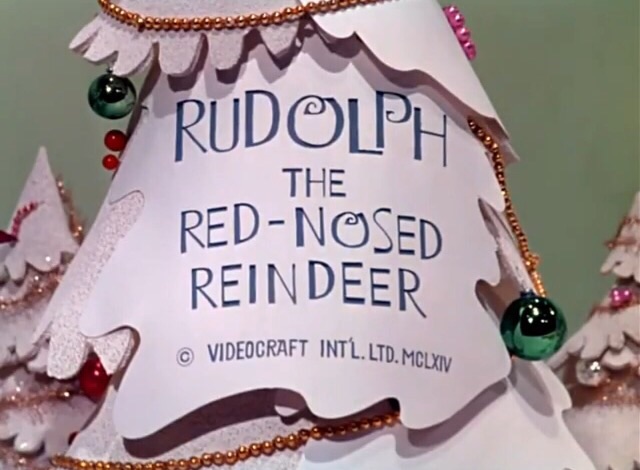
The television special came in 1964. Arthur Rankin Jr. and Jules Bass produced it through their company, Videocraft International, the outfit the world now knows as Rankin/Bass. The writer was Romeo Muller, who built a whole world out of a three-minute song: a dentist elf, a prospector, a snow monster, and an island that is not in the song at all. Muller invented the island.
The special was made in stop motion, a process they trademarked as Animagic: puppets built in New York, animated frame by frame in Tokyo, voiced mostly by Canadians in Toronto, music recorded in England. Eighteen months of work, paid for by the sponsor, General Electric. It aired on NBC on December 6, 1964, with Burl Ives as Sam the Snowman, telling you the story like a man who was there.
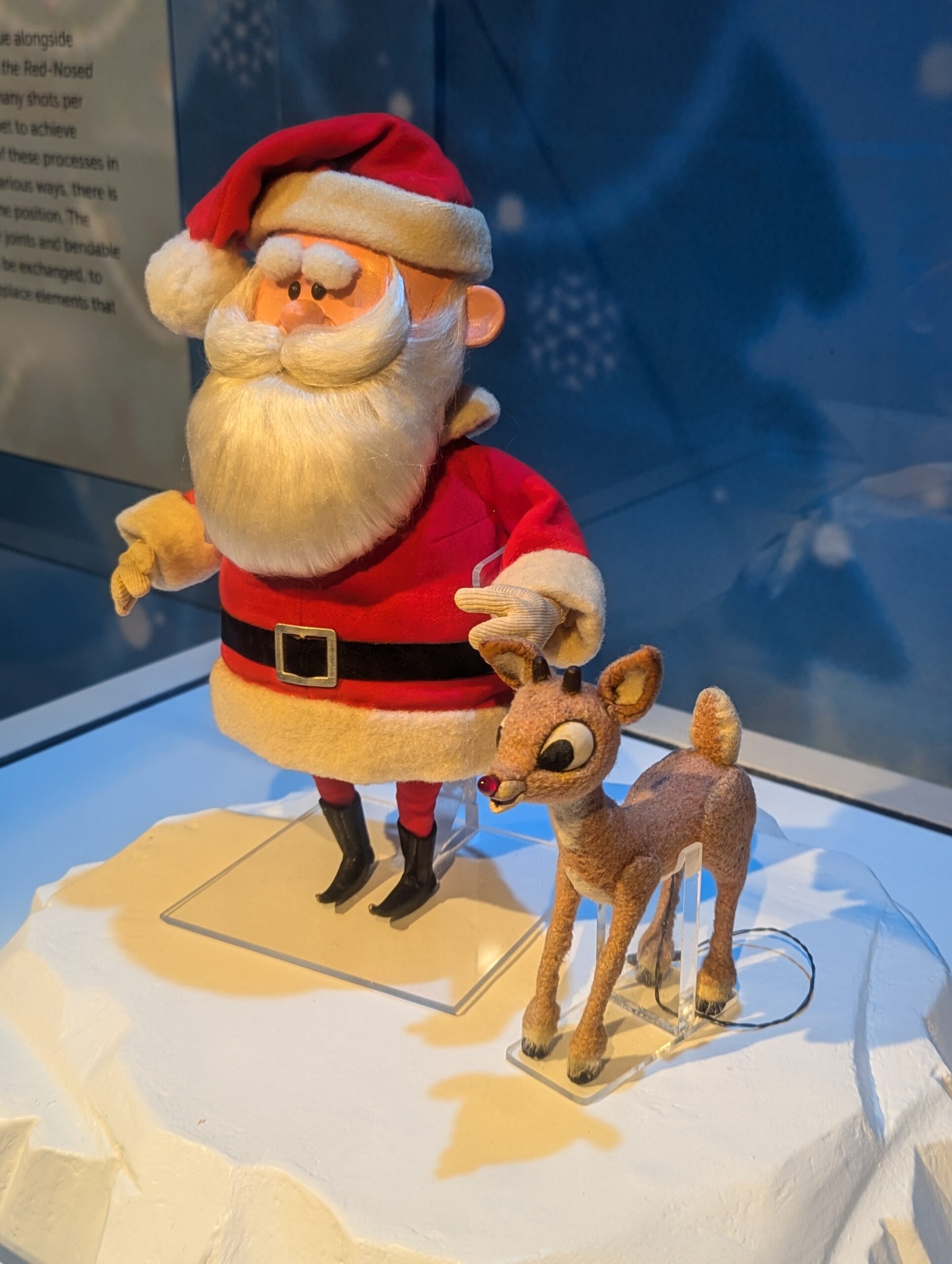
The original Santa and Rudolph puppets from the 1964 special, photographed on display at the Center for Puppetry Arts. Photo via Wikimedia Commons.
It has aired every year since, the longest running Christmas special in television history. And Rankin and Bass went on to build a whole shelf of these things: The Little Drummer Boy, Frosty, Santa Claus Is Comin’ to Town, The Year Without a Santa Claus. But the island is the room in that universe that people never stopped thinking about.
Charlie in the Box
Rudolph and Hermey wash up there fleeing the Abominable Snow Monster. The first citizen they meet is the sentry, a jack-in-the-box. He pops up, and Rudolph guesses his name is Jack. It is not Jack. His name is Charlie. That is the whole tragedy. In his own words, no child wants to play with a Charlie in the Box. He is not broken, and he works fine. He is a perfectly good toy with the wrong name, and that was enough to exile him.
Then comes the song, The Most Wonderful Day of the Year, and it might be the saddest happy song ever put in a Christmas special, because what they are singing about is the day somebody finally comes for them. One by one, they introduce themselves. One by one, you realize none of them is ruined.
There is a polka-dot elephant. Just an elephant with spots. Somewhere, a factory decided elephants do not come spotted, and that was that.
There is a train with square wheels on its caboose. A cowboy who rides an ostrich. A bird that swims instead of flying. There is a word for a bird that swims instead of flying. The word is penguin.
There is a water pistol that shoots jelly. A boat that cannot stay afloat. A plane that cannot fly. A scooter with its wheels in the wrong order. Teddy bears, nesting clowns, and at the very bottom of the smallest clown, a wind-up mouse.
And then there is Dolly. We will come back to her.
The King Who Does Not Fix Anybody
Moonracer receives them in his castle, and here is the part nobody warns you about: he will not let Rudolph and Hermey stay. Living creatures, he tells them, cannot hide themselves away on an island. Instead, he hands them a job. When you go back to Christmastown, tell Santa about our homeless toys. I am sure he can find little boys and girls who would be happy with them. Then he says the line the whole special is built around. A toy is never truly happy until it is loved by a child.
Notice what Moonracer does not do. He does not fix anybody. He does not repaint the elephant, or round off the train’s wheels, or rename Charlie. He keeps them safe, he keeps them together, and he waits for the match. The island is not a repair shop. It is a waiting room, run by a king who refuses to give up on anybody in it.
The Ending the Audience Rewrote
When the special first aired in December of 1964, Santa never came back for them on screen. Santa promised Rudolph he would find homes for them, and late in the show he even announced the island would be his next stop. Then the sleigh flew off, the credits rolled, and the toys were never seen again. The promise was made. The promise was not shown.
And viewers wrote letters. Jules Bass said it himself: there was a write-in protest from viewers, and we added it in the following year. Think about who was writing those letters. Kids, who had just been told a story about unwanted toys, watched the story walk away from them, and sat down and did something about it. It has to be one of the first times an audience reached into a finished show and changed the ending.
So for the 1965 broadcast, Rankin and Bass animated the rescue. Santa’s sleigh lands on the island, and in the new closing credits an elf drops the toys down to the children waiting below, most of them floating down under little umbrellas. Something had to go to make room: Yukon Cornelius’s payoff, the scene where he strikes a peppermint mine, which is why he licks his pickaxe through the whole show. For over thirty years, audiences watched a man taste his tools for no explained reason. The peppermint scene came back in 1998. The rescue never left again.
One more small heartbreak hides inside that added ending. In the new credits, the elf hands an umbrella to every toy as he drops it. Every toy except the bird. The bird, whose whole problem is that he cannot fly, gets tossed out of the sleigh bare. Somebody at that studio either missed it, or had a darker sense of humor than the rest of us. At this point, nobody should ever fix it.
Dolly
Which brings us back to Dolly.
Run the lineup again. Square wheels. A jelly pistol. A spotted elephant. And then a perfectly ordinary rag doll with red hair, with nothing visibly wrong with her at all. For decades, viewers asked the same question you are asking right now: what is she doing there?
The script never says. The Rankin/Bass historian Rick Goldschmidt checked the scripts himself: there is nothing in them about the misfit doll. So people asked Arthur Rankin for years, and Rankin finally answered. On NPR in 2007, he said her problem was psychological. She had been cast off by the girl she was made for, and she was depressed from feeling unloved. Goldschmidt quotes him putting it blunter: she was cast off by her mistress and clinically depressed, and they did not have Prozac back then.
Rankin also admitted the plainer truth underneath it. Dolly was a late addition. The island was full of boys’ toys, and the producers wanted one the girls watching could see themselves in. Then the 1965 rescue scene gave her more screen time, which made the question louder.
But sit with Rankin’s joke answer a minute, because jokes from the man who built the island tend to be true in disguise. Every other toy up there has a flaw you can point at. Dolly’s is invisible. She looks fine, and she is not fine. Of all the misfits, she might be the most honest portrait on the island: nothing wrong with the workmanship. Just unwanted, and carrying it.
And then there is the thing half the audience swears they remember, and cannot find. Ask around, and people will tell you, flat certain, that Dolly had no mouth. They can see her without one, plain as a photograph. Watch the special and there she is, mouth and all, in every version anybody can put on a screen. Nobody can prove the mouthless Dolly ever existed, and nobody who remembers her will give her up either. A misfit toy so misfit that even the memory of her does not fit the footage. In a story about things being slightly off, she is off in a way nobody scripted.
The Case for the Show
So here is the case, plainly. The Island of Misfit Toys needs its own show.
Not a Rudolph reboot. Rudolph got his ending. The island never got its story. Think about what is sitting there in the middle of the most rewatched Christmas special ever made. A flying lion king with no explained origin, doing rescue work nobody thanks him for. A castle full of characters, and every one of them is an episode: how the elephant got his spots, who built a train with square wheels and shipped it anyway. Every episode could open the same way: Moonracer coming home through the dark with one more rescued toy, and the island making room.
It has nearly happened, in pieces. The island got top billing once, in 2001, in a direct-to-video attempt almost nobody saw, made without Rankin and Bass and never sanctioned by the people who built the place. An attempt. Not the real deal. The toys themselves became best-selling ornaments, which is the universe’s best joke: the unwanted toys turned out to be extremely wanted. And the audience for this show has been standing in line for sixty years.
And the show already has its rule, Moonracer’s rule. Nobody gets fixed to earn their place. Being off is the admission ticket. The story is not how they become normal. The story is the wait, and the company, and the night somebody finally comes.
Wanted, As Is
Why does this land so hard now? Because the island stopped being a metaphor a while ago.
We live in a stretch of years where a lot of people feel slightly wrong for the slot the world has open. People who work exactly as built still get passed over, because the label is wrong, or the timing is wrong, or the factory does not make their kind anymore. Charlie is not broken. Charlie is a naming problem with a heart. The elephant is not broken either. He is a variation that somebody in quality control called a defect.
And the special never argues the toys should just learn to love the island and stay there. The island is kind, but it is not the destination. Moonracer’s whole gospel is that they belong in the hands of a child who wants them exactly as they are. Not repaired. Not renamed. Wanted, as is. There is a difference between being fixed and being wanted, and that difference is the entire engine of the thing. Most of us do not need to be fixed. We need to be matched.
That is also why the 1964 ending hurt enough to generate mail. The audience was not asking for a happier ending in general. They were asking for the promise to be kept on screen, where they could see it. People who feel off do not need to be told it all works out. They need to see the sleigh land.
So yes. Give the island its own show. Give Moonracer his nights, and Charlie his watch at the gate, and Dolly a storyline where somebody finally asks her how she is doing. Until then, they are still out there, in the most rewatched hour in television history, singing about the most wonderful day of the year, which for them is not exactly Christmas. It is the day somebody comes.
Every night, a lion with wings flies around the world looking for toys nobody wants. He has never once come home empty, and he has never once given up on the ones he brought back. If that is not a show, nothing is.