Smart Dust Could Spy On Your Brain
Intelligent dust particles embedded in the brain could form an entirely new form of brain-machine interface. The brain is whispering constantly, and only now do we have the tools to eavesdrop at scale. Neural dust—microscopic, ultrasound-powered sensors—promises a revolution, letting us monitor neurons in real time without bulky wires or invasive machinery.
Tiny Sensors, Big Vision
Traditional brain monitoring relies on fMRI, PET scans, and MEG, impressive but clunky, low-resolution, and often invasive. They reveal patterns but miss the micro-details: how clusters of neurons interact in real life. Neural dust changes that by being small enough to sit inside the cortex, acting like thousands of tiny scouts reporting activity wirelessly.

Neural Dust: An Ultrasonic, Low Power Solution for Chronic Brain-Machine Interfaces
These dust particles are just 100 micrometers wide, embedding CMOS circuits and piezoelectric materials. Ultrasound both powers them and reads their responses. Think RFID for your neurons: each pulse translates electrical activity into readable data, all without tethered wires or implanted batteries.
Neural dust is like planting micro-spies in your cortex. Ultrasound powers them, neurons talk, we listen. #Neurodope #BrainTech #NeuralDust share this

AI reads neural gossip better than your closest friend ever could.
Overcoming the Limits of Modern BMIs
Brain-machine interfaces have struggled with invasiveness, poor resolution, and short lifespans. Neural dust sidesteps these issues: low power, high spatial resolution, portable, and capable of long-term monitoring. Each particle sends data to an external device, keeping the brain free of bulky implants.
The challenge isn’t small. Engineering sensors that survive a wet, warm, and noisy biological environment while converting sound to electricity is monumental. Encapsulation, electrode exposure, and signal fidelity all need precision at a microscopic scale. It’s the kind of engineering where a single micron can make or break the system.
Old BMIs were clunky, invasive, short-lived. Neural dust is wireless, small, and brain-friendly. #Neurodope #BrainTech #NeuralInterfaces share this

But who is spying on who?
Ultrasound: The Power Behind the Dust
Electromagnetic signals would overheat the tissue, making them impractical at this scale. Ultrasound, on the other hand, delivers 10 million times more power efficiently, keeping neurons safe while powering dust particles. It’s a wireless handshake between the cortex and the outside world.
The system also requires clever packaging: insulating polymers that protect electronics while exposing electrodes to neurons, all synchronized with the ultrasound generator outside the skull. It’s a delicate ballet of mechanics, electronics, and biology. When it works, the result is a tetherless neural map that could persist for years.
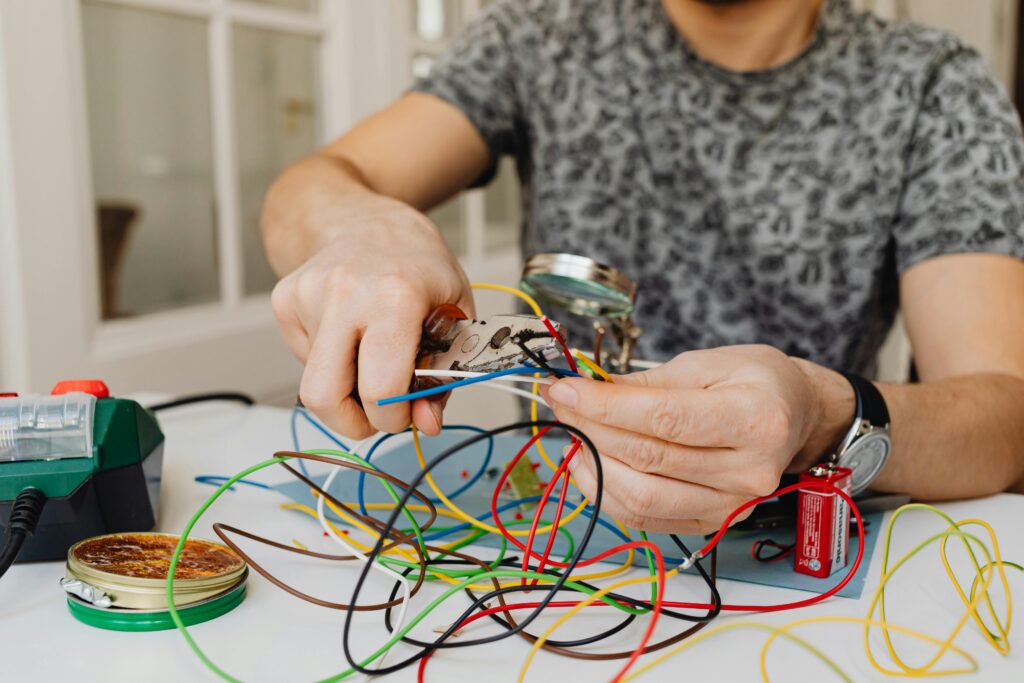
Fine wire arrays help implant neural dust particles in the cortex, enabling precision placement and stable monitoring.
Ultrasound powers neural dust safely, letting micro-sensors eavesdrop on the cortex without frying it. #Neurodope #BrainTech #NeuralDust share this
Implantation and Ambition
Embedding neural dust in the cortex might involve coating fine wire arrays with the particles, then dipping them in—particles detach and settle in place. Ambitious? Absolutely. Feasible? With a team experienced in nanoelectronics and biointerfaces, possibly. This is the same crew that remotely controlled a beetle, earning recognition as a top emerging tech.
The human brain: a web of neural fire shaping our reality and awareness.
The hurdles are vast: fabrication, implantation, signal fidelity, power efficiency. But if successful, we could see lifelong, real-time neural monitoring, a dream for neuroscience, neurology, and even brain-machine interfaces. The whispers of neurons may soon become a clear, analyzable conversation. Kudos to anyone who followed the full story—they’re already thinking in neural dust.
Implanting neural dust is sci-fi made real: tiny wireless sensors listen to neurons for a lifetime. #Neurodope #BrainTech #NeuralInterfaces share this

Exploring the known and the unknown with a beat writer’s eye for truth. -Chip Von Gunten
A quick overview of the topics covered in this article.
Latest articles

“In a time of deceit telling the truth is a revolutionary act.” – George Orwell
"In a time of deceit telling the truth is a revolutionary act." - George Orwell

“A problem cannot be solved by the same consciousness that created it.” – Albert Einstein
“A problem cannot be solved by the same consciousness that created it.” - Albert Einstein

“All truth passes through three stages. First, it is ridiculed. Second, it is violently opposed. Third, it is accepted as being self-evident.” – Arthur Schopenhauer
"All truth passes through three stages. First, it is ridiculed. Second, it is violently opposed. Third, it is accepted as being self-evident." - [read more...]

